Difference between revisions of "Iso-Plane"
Wiki.admin (talk | contribs) (Created page with "= ISO-Plane = == Overview == The '''ISO-Plane''' is an open collaborative aerospace project aiming to design the smallest dedicated cargo aircraft capable of transporting a...") |
Wiki.admin (talk | contribs) |
||
| Line 10: | Line 10: | ||
---- | ---- | ||
| + | |||
| + | <gallery mode="packed" heights="250"> | ||
| + | File:Iso plane loading system.png|Autonomous loading system | ||
| + | File:Internal loading.png|Internal cargo integration | ||
| + | File:Iso plane with mediacal container.png|Medical container mission configuration | ||
| + | </gallery> | ||
| + | |||
== Mission Statement == | == Mission Statement == | ||
Revision as of 13:16, 13 February 2026
ISO-Plane
Overview
The ISO-Plane is an open collaborative aerospace project aiming to design the smallest dedicated cargo aircraft capable of transporting a single 20-foot ISO container autonomously.
The project was initiated in 2012 and is currently developed under the Lesser Open Bee License 1.3, combining academic research, industrial collaboration, and open innovation principles.
The objective is to create a light, efficient, and operationally autonomous aircraft capable of transporting a standard 20-foot ISO container (up to 8 tons payload) directly from ground or truck to aircraft without external loading infrastructure.
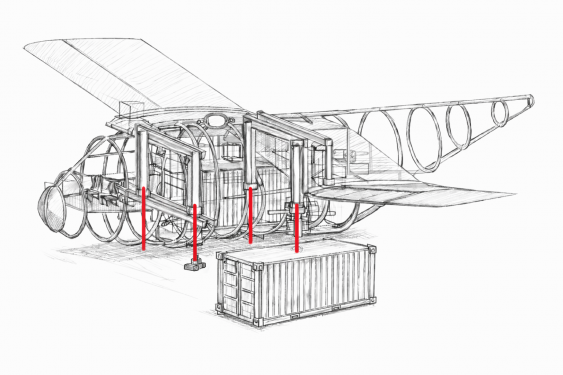
Autonomous loading system
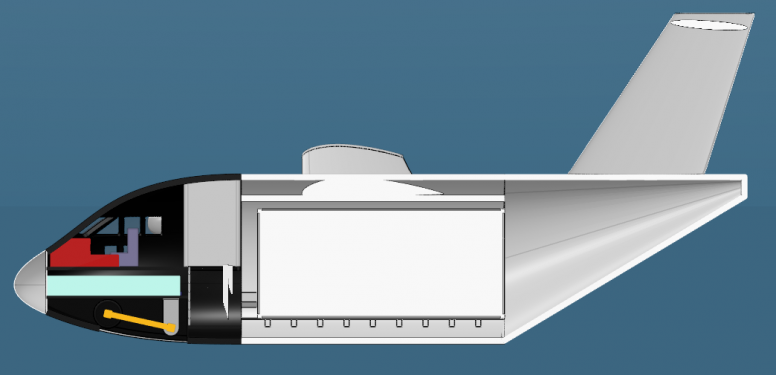
Internal cargo integration
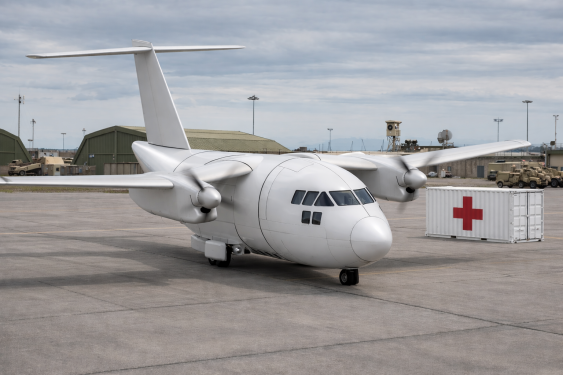
Medical container mission configuration


Mission Statement
The ISO-Plane addresses a structural gap in air logistics:
- Today, aircraft capable of transporting full ISO containers are large military platforms (e.g., C-130 class).
- Smaller regional cargo aircraft cannot accommodate standard ISO containers.
- Current air freight requires complex palletization and ground logistics.
ISO-Plane proposes a new paradigm:
- Direct transport of a 20-foot ISO container
- Autonomous loading/unloading
- Operation from conventional runways
- Minimal ground infrastructure
- Two-pilot crew
- Potential multi-role capability (including water bombing via container module)
Key Technical Characteristics
| Parameter | Value |
|---|---|
| Container | 1 × 20-foot ISO container (ISO 668 standard) |
| Payload | Up to 8 tons |
| MTOW (est.) | ~30 tons |
| Range | Up to 6000 km (mission dependent) |
| Engines | 2 × Pratt & Whitney PW150A turboprop engines |
| Wing Configuration | High wing |
| Architecture | Twin-boom configuration |
| Landing Gear | Q400-derived, retracting into engine nacelles |
| Cargo System | Ventral three-panel cargo door + robotic lifting arms |
Cargo Handling Concept
The defining innovation of the ISO-Plane is its autonomous container handling system.
Ventral Cargo Door
The aircraft features a three-panel ventral opening mechanism allowing:
- Ground-level loading
- Direct truck-to-aircraft transfer
- Pressurized cargo bay compatibility
- Structural integrity preservation
Robotic Lifting Arms
The container is handled using:
- Four mechanized robotic arms
- ISO corner twist-lock interface
- Autonomous alignment and positioning
- Backup winch system (4 electric winches)
This allows loading:
- Directly from ground
- From a truck in reverse alignment
- Without external cranes or loaders
Aircraft Architecture
Engines
The selected powerplant is the Pratt & Whitney PW150A turboprop, chosen for:
- Proven reliability (Q400 platform)
- Adequate power-to-weight ratio
- Compatibility with ~30t MTOW target
Landing Gear
The main landing gear is derived from the Bombardier Q400:
- Retracts into nacelles below high-mounted wings
- Preserves ventral cargo bay clearance
- Optimizes aerodynamic efficiency
Wing & Structure
- High-wing configuration for ground clearance
- Central wing box optimized for structural continuity
- Pressurized cockpit and cargo compartment
- 4m fuselage diameter for ISO container integration
Technology Readiness & Development
The project has evolved through several TRL stages:
- TRL0 (2012–2014) – Conceptual exploration
- TRL1 (2015–2018) – Preliminary architecture definition
- TRL2 (2024–2025) – Digital mock-up and validated configuration
TRL2 achievements include:
- Validated architectural choices
- 3D digital mock-up
- Structural concept refinement
- Functional analysis
- Market and economic study
- Carbon footprint estimation (operational phase)
The project is currently preparing for TRL3 – detailed engineering design.
Collaborative Model
The ISO-Plane is developed through academic–industrial collaboration including:
- ESTACA
- ENSTA Paris
- Student engineering teams
- Aerospace professionals
The project is structured around:
- Work Breakdown Structure (WBS)
- Functional analysis
- Architecture trade studies
- Market analysis
- System integration studies
All open contributions are published under the Lesser Open Bee License 1.3.
Industrial partners may integrate private modules while preserving the open architecture core.
Market Positioning
Air cargo represents:
- ~1% of global freight volume
- ~35% of freight value
The ISO-Plane targets:
- Tactical logistics
- Remote area supply
- Military container transport
- Disaster relief operations
- Firefighting (modular container-based water system)
Preliminary market analysis estimates:
- 12 aircraft/year production target
- 10-year horizon
- Approx. €130M unit price (conceptual estimation)
Environmental Considerations
Operational carbon footprint (baseline estimate):
- ~3400 kg fuel per 2-hour mission
- ~10–11 tons CO₂ per mission
- ~9000–11000 tons CO₂ annually (900 flights/year)
Future development directions include:
- Sustainable Aviation Fuel (SAF)
- Structural weight optimization
- Eco-design principles
- Hybridization studies (long-term)
Future Development
Next steps (TRL3):
- Detailed structural calculations
- Aerodynamic refinement
- Finite Element Analysis (FEA)
- CFD studies
- Cargo door structural validation
- Detailed lifting mechanism design
- Industrial partnerships (engines, landing gear, systems)
Join the Project
ISO-Plane is an open collaborative aerospace initiative.
Engineers, students, researchers, and industry stakeholders are welcome to contribute.
For collaboration inquiries and technical documentation:
- www.iso-plane.com
ISO-Plane – Rethinking container air logistics.