Iso-Plane
ISO-Plane™
|
Container Air Logistics One container. One aircraft. One mission. ISO-Plane™ is an open collaborative aerospace project developing a dedicated light cargo aircraft capable of transporting a single 20-foot ISO container with autonomous loading and unloading. Designed around the container — not around conventional palletized cargo — ISO-Plane aims to offer a new operational standard for fast, infrastructure-light air logistics. The aircraft concept targets: direct transport of one ISO container, autonomous cargo handling from ground or truck trailer, operation from regular landing fields, and multi-role mission capability. |
| ||||||||||||||
Executive Overview
The ISO-Plane is a specialized cargo aircraft concept designed to solve a structural gap in air freight: transporting a standard ISO container without requiring a large military-class aircraft or heavy ground loading infrastructure.
Today, aircraft capable of carrying a full ISO container are generally large platforms requiring substantial logistics support. Smaller cargo aircraft are efficient for regional operations but are not built around ISO container geometry. ISO-Plane addresses this gap by placing the 20-foot container at the center of the aircraft architecture.
|
Container-first architecture The cargo bay, ventral door, lifting system and fuselage diameter are designed around one 20-foot ISO container. |
Autonomous handling Loading and unloading can be performed from the ground or directly from a truck trailer using onboard mechanisms. |
Multi-role platform The same airframe can support logistics, humanitarian operations, firefighting, medical modules and special missions. |
Product Positioning
The Market Gap
|
The ISO-Plane Answer
|
ISO-Plane proposes a new paradigm: containerized air logistics with minimal ground infrastructure.
Mission Applications
| Mission | Operational Value |
|---|---|
| Logistics Operations | Rapid movement of high-value, urgent or strategic containerized cargo to remote or constrained locations. |
| Humanitarian Aid / Relief Operations | Deployment of medical, shelter, water, energy or communications modules after disasters. |
| Aerial Firefighting | Potential water-bombing capability using a dedicated containerized water module. |
| Special Missions / Defense Operations | Tactical transport of modular systems, sensitive cargo or mobile support infrastructure. |
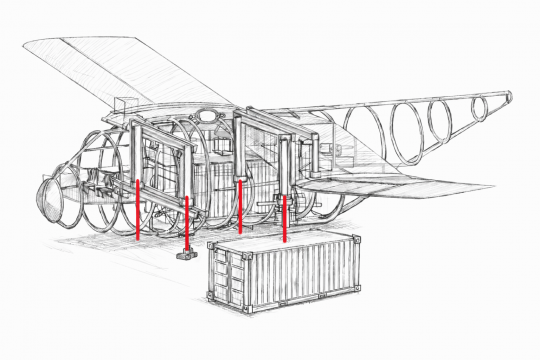
Autonomous loading system
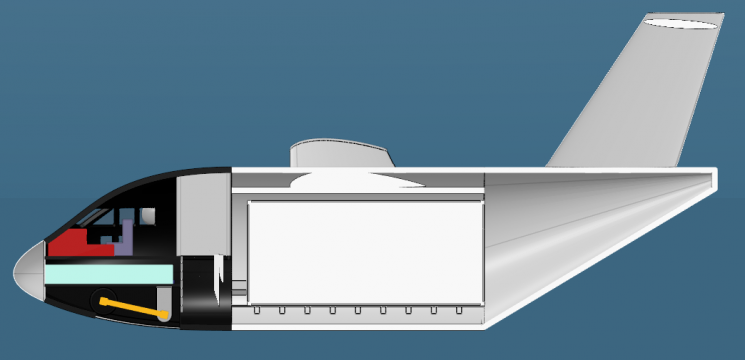
Internal cargo integration
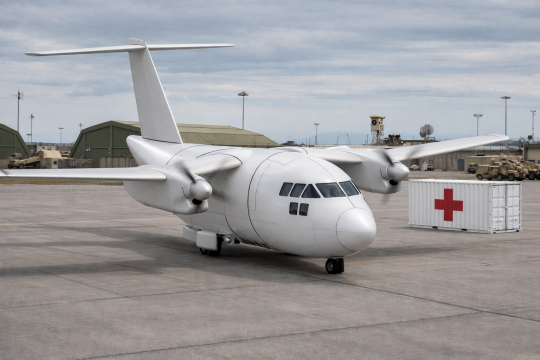
Medical container mission configuration


Key Technical Characteristics
| Parameter | Value |
|---|---|
| Container | 1 × 20-foot ISO container, ISO 668 standard |
| Payload | Up to 8 tons |
| Estimated MTOW | Approximately 30 tons |
| Range | Up to 6,000 km, mission dependent |
| Engines | 2 × Pratt & Whitney PW150A turboprop engines |
| Wing configuration | High wing |
| Architecture | Twin-boom configuration |
| Landing gear | Q400-derived, retracting into engine nacelles |
| Cargo bay | Pressurized cargo compartment |
| Cargo system | Ventral three-panel cargo door and robotic lifting arms |
| Crew | Two pilots |
Cargo Handling System
The defining innovation of the ISO-Plane is its integrated autonomous container handling system.
Ventral Cargo Door
The aircraft features a three-panel ventral opening mechanism designed to provide direct access to the container from below the fuselage.
This system enables:
- Ground-level loading and unloading.
- Direct truck-to-aircraft transfer.
- Compatibility with a pressurized cargo bay architecture.
- Preservation of structural continuity through separated opening functions.
Robotic Lifting Arms
The container is handled by onboard mechanized systems:
- Four robotic lifting arms.
- ISO corner twist-lock interface.
- Autonomous alignment and positioning logic.
- Backup system using four electric winches.
Loading scenarios include:
- Container positioned directly on the ground.
- Container positioned on a truck trailer behind the aircraft.
- Aircraft or truck alignment followed by automatic lifting, locking and securing.
|
1. Align Aircraft and container are aligned using the selected ground scenario. |
2. Open Rear and ventral cargo doors open to release the container access volume. |
3. Lock & Lift Robotic arms connect to ISO corners and lift the container. |
4. Secure The container is positioned, locked and prepared for flight. |
Aircraft Architecture
Engines
The selected powerplant is the Pratt & Whitney PW150A turboprop, chosen for its compatibility with the targeted aircraft class and its use on the Q400 platform.
Key advantages:
- Proven turboprop architecture.
- Power level compatible with an estimated 30-ton MTOW class.
- Integration opportunity with Q400-derived systems.
Landing Gear
The main landing gear is derived from the Bombardier Q400.
Design principle: the main landing gear retracts into the nacelles below the high-mounted wings to maintain clearance with the cargo bay.
This configuration:
- Preserves the ventral cargo opening.
- Avoids interference with the container bay.
- Reduces landing gear leg length compared with a lower fuselage installation.
- Supports the high-wing cargo architecture.
Wing & Structure
The ISO-Plane architecture includes:
- High-wing configuration for ground and container clearance.
- Twin-boom layout.
- Central wing box designed for structural continuity.
- Pressurized cockpit and cargo compartment.
- Fuselage diameter sized for ISO container integration.
Technology Review
| Technology Block | Purpose | Status |
|---|---|---|
| 20-foot container integration | Native cargo unit for the aircraft | Validated concept |
| Ventral three-panel cargo door | Ground-level access and container clearance | Selected architecture |
| Rear cargo door | Access and alignment support during loading | Under detailed refinement |
| Robotic arms | Container lifting, stabilization and positioning | Concept validated at TRL2 |
| Twist-lock interface | ISO corner fixation and structural locking | Retained principle |
| PW150A engines | Twin-turboprop propulsion | Selected baseline |
| Q400-derived landing gear | Landing gear integration in nacelles | Selected baseline |
Development Status
The ISO-Plane project is developed through a progressive technology readiness approach.
| Phase | Period | Main Achievements |
|---|---|---|
| TRL0 | 2012–2014 | Initial concept exploration and aircraft architecture studies. |
| TRL1 | 2015–2018 | Preliminary architecture definition and early cargo loading concepts. |
| TRL2 | 2024–2025 | Digital mock-up, validated architectural choices, functional analysis and cargo loading scenarios. |
| TRL3 | 2026 onward | Detailed engineering studies, structural calculations, CFD, FEA and subsystem validation. |
TRL2 achievements include:
- Validated aircraft configuration.
- 3D digital mock-up.
- Functional analysis.
- Market and economic study.
- Cargo handling scenarios.
- Preliminary carbon footprint estimation.
TRL3 focus areas include:
- Detailed structural calculations.
- Aerodynamic refinement.
- Finite Element Analysis.
- CFD studies.
- Cargo door structural validation.
- Detailed lifting mechanism design.
- Industrial partnerships for engines, landing gear and onboard systems.
Collaborative Model
ISO-Plane is developed as an open collaborative aerospace initiative under the Lesser Open Bee License 1.3.
The project combines:
- Academic engineering contributions.
- Industrial expertise.
- Open technical documentation.
- Architecture-level collaboration.
- Potential private industrial modules integrated around an open core.
Known contributors and collaboration environments include:
File:20260512 BDX présentation Iso plane.pptx
- ESTACA.
- ENSTA Paris.
- Student engineering teams.
- Aerospace professionals and technical coordinators.
- Technoplane and Collaborative Bee ecosystem.
Market Positioning
The ISO-Plane targets premium and strategic segments where speed, autonomy and direct container compatibility create operational value.
Target Users
|
Value Proposition
|
Preliminary market analysis has considered a production target around 12 aircraft per year over a 10-year horizon, with a conceptual unit price estimate around €130 million. These figures remain preliminary and must be refined during business plan development.
Environmental Considerations
Operational carbon footprint studies have been initiated during the concept phase.
Baseline assumptions considered:
- Around 3,400 kg of fuel for a 2-hour mission.
- Around 10–11 tons of CO₂ per mission.
- Around 9,000–11,000 tons of CO₂ annually for approximately 900 flights per year.
Future development directions include:
- Sustainable Aviation Fuel compatibility studies.
- Structural weight optimization.
- Eco-design principles.
- Aerodynamic refinement.
- Long-term hybridization studies.
Why ISO-Plane?
|
01 Direct container transport A standard 20-foot ISO container becomes an airborne mission module. |
02 Autonomous logistics The aircraft carries its own loading and unloading capability. |
03 Operational flexibility One platform can serve logistics, relief, firefighting and special missions. |
04 Collaborative innovation Open architecture principles help accelerate development and partnerships. |
Join the Project
ISO-Plane is an open collaborative aerospace initiative welcoming engineers, students, researchers and industry stakeholders.
Collaboration opportunities include:
- Aerodynamic studies.
- Structural sizing.
- Cargo door mechanisms.
- Robotic lifting systems.
- Systems integration.
- Market analysis and business model refinement.
- Certification and industrialization studies.
For collaboration inquiries and technical documentation:
| Programme note: ISO-Plane is presented here as a development programme and partnership opportunity. The aircraft is not presented as certified or commercially available for operational service at this stage. |
ISO-Plane™ — Rethinking container air logistics.