Difference between revisions of "Mini-Bee"
Wiki.admin (talk | contribs) |
Wiki.admin (talk | contribs) |
||
| Line 5: | Line 5: | ||
[[Category:Hybrid Propulsion]] | [[Category:Hybrid Propulsion]] | ||
| − | + | __NOTOC__ | |
| − | + | <div style="font-family:Arial, Helvetica, sans-serif; color:#142033; line-height:1.55;"> | |
| − | + | <!-- ===================================================== --> | |
| + | <!-- HERO SECTION --> | ||
| + | <!-- ===================================================== --> | ||
| − | + | <div style="position:relative; overflow:hidden; border-radius:28px; background:linear-gradient(135deg,#07111f 0%,#10233d 48%,#7f1d1d 100%); color:white; padding:42px 42px 34px 42px; margin:0 0 28px 0; box-shadow:0 24px 60px rgba(15,23,42,0.28);"> | |
| + | <div style="max-width:1180px; margin:auto;"> | ||
| + | <div style="display:inline-block; padding:7px 13px; border:1px solid rgba(255,255,255,0.22); border-radius:999px; background:rgba(255,255,255,0.08); font-size:13px; letter-spacing:0.08em; text-transform:uppercase; color:#e5e7eb;"> | ||
| + | TRL4 demonstrator · Hybrid VTOL · Humanitarian aviation | ||
| + | </div> | ||
| − | + | <h1 style="font-size:50px; line-height:1.02; margin:22px 0 14px 0; max-width:900px; font-weight:800; letter-spacing:-0.04em;"> | |
| + | Mini-Bee Hybrid VTOL | ||
| + | </h1> | ||
| − | + | <p style="font-size:21px; max-width:900px; color:#dbeafe; margin:0 0 26px 0;"> | |
| + | A collaborative hybrid VTOL multicopter concept designed for urgent humanitarian missions, light air ambulance operations, emergency logistics and rapid field deployment without runway dependency. | ||
| + | </p> | ||
| − | + | <div style="border-radius:24px; overflow:hidden; background:rgba(255,255,255,0.06); border:1px solid rgba(255,255,255,0.14); padding:10px; margin:28px 0;"> | |
| − | + | [[File:01_hero_principal_minibee.png|1200px|center|Mini-Bee Hybrid VTOL – humanitarian mission concept]] | |
| − | + | </div> | |
| − | + | ||
| + | <div style="display:grid; grid-template-columns:repeat(4,minmax(120px,1fr)); gap:14px; margin-top:24px;"> | ||
| + | <div style="background:rgba(255,255,255,0.10); border:1px solid rgba(255,255,255,0.16); border-radius:18px; padding:18px;"> | ||
| + | <div style="font-size:34px; font-weight:800;">18</div> | ||
| + | <div style="font-size:13px; color:#cbd5e1; text-transform:uppercase; letter-spacing:0.08em;">distributed rotors</div> | ||
| + | </div> | ||
| + | <div style="background:rgba(255,255,255,0.10); border:1px solid rgba(255,255,255,0.16); border-radius:18px; padding:18px;"> | ||
| + | <div style="font-size:34px; font-weight:800;">450 km</div> | ||
| + | <div style="font-size:13px; color:#cbd5e1; text-transform:uppercase; letter-spacing:0.08em;">target range</div> | ||
| + | </div> | ||
| + | <div style="background:rgba(255,255,255,0.10); border:1px solid rgba(255,255,255,0.16); border-radius:18px; padding:18px;"> | ||
| + | <div style="font-size:34px; font-weight:800;">160 km/h</div> | ||
| + | <div style="font-size:13px; color:#cbd5e1; text-transform:uppercase; letter-spacing:0.08em;">cruise speed</div> | ||
| + | </div> | ||
| + | <div style="background:rgba(255,255,255,0.10); border:1px solid rgba(255,255,255,0.16); border-radius:18px; padding:18px;"> | ||
| + | <div style="font-size:34px; font-weight:800;">700 kg</div> | ||
| + | <div style="font-size:13px; color:#cbd5e1; text-transform:uppercase; letter-spacing:0.08em;">MTOW target</div> | ||
| + | </div> | ||
| + | </div> | ||
| + | </div> | ||
| + | </div> | ||
| + | |||
| + | <!-- ===================================================== --> | ||
| + | <!-- INTRO SUMMARY --> | ||
| + | <!-- ===================================================== --> | ||
| + | |||
| + | <div style="display:grid; grid-template-columns:2fr 1fr; gap:24px; margin:28px 0;"> | ||
| + | <div style="background:white; border:1px solid #e2e8f0; border-radius:24px; padding:28px; box-shadow:0 10px 34px rgba(15,23,42,0.08);"> | ||
| + | <p style="font-size:18px; margin-top:0;"> | ||
| + | <strong>Mini-Bee</strong> is a collaborative hybrid VTOL multicopter project coordinated by <strong>Technoplane SAS</strong> under the <strong>Lesser Open Bee License 1.3</strong>. | ||
| + | </p> | ||
| + | <p> | ||
| + | The current reference configuration is the <strong>Mini-Bee P2H18</strong>: a two-seat hybrid VTOL multicopter using <strong>18 distributed rotors</strong>, a <strong>Rotax 916 iS</strong> thermal engine, twin <strong>EMRAX 208</strong> high-voltage electric machines, supercapacitor support and computerized flight control. | ||
| + | </p> | ||
| + | <p style="margin-bottom:0;"> | ||
| + | <strong>Current maturity level:</strong> TRL4 – demonstrator stage. | ||
| + | </p> | ||
| + | </div> | ||
| + | |||
| + | <div style="background:#0f172a; color:white; border-radius:24px; padding:28px; box-shadow:0 10px 34px rgba(15,23,42,0.16);"> | ||
| + | <div style="font-size:13px; letter-spacing:0.1em; text-transform:uppercase; color:#93c5fd; margin-bottom:14px;">Official links</div> | ||
| + | <ul style="margin:0; padding-left:20px;"> | ||
| + | <li>[https://www.mini-bee.com/ Mini-Bee website]</li> | ||
| + | <li>[https://wiki.collaborativebee.com/ Collaborative Bee Wiki]</li> | ||
| + | <li>[http://www.bee-license.com/ Lesser Open Bee License 1.3]</li> | ||
| + | </ul> | ||
| + | </div> | ||
| + | </div> | ||
| + | |||
| + | <!-- ===================================================== --> | ||
| + | <!-- PROJECT VISION --> | ||
| + | <!-- ===================================================== --> | ||
== Project Vision == | == Project Vision == | ||
| − | Mini-Bee is not only a VTOL technology demonstrator. It is designed around a mission need: reaching people and equipment in difficult environments where conventional ground access is slow, damaged or unavailable. | + | <div style="background:#f8fafc; border-left:6px solid #dc2626; border-radius:18px; padding:24px 28px; margin:18px 0 24px 0;"> |
| + | <p style="font-size:18px; margin:0;"> | ||
| + | Mini-Bee is not only a VTOL technology demonstrator. It is designed around a mission need: reaching people and equipment in difficult environments where conventional ground access is slow, damaged or unavailable. | ||
| + | </p> | ||
| + | </div> | ||
| − | + | <div style="display:grid; grid-template-columns:repeat(3,minmax(0,1fr)); gap:16px; margin:24px 0;"> | |
| + | <div style="background:white; border:1px solid #e2e8f0; border-radius:20px; padding:22px; box-shadow:0 8px 24px rgba(15,23,42,0.06);"> | ||
| + | <div style="font-size:22px; font-weight:800; color:#991b1b; margin-bottom:8px;">Medical response</div> | ||
| + | <p style="margin:0; color:#475569;">Rapid access for a pilot, doctor, operator or stabilized passenger in areas where ground routes are disrupted.</p> | ||
| + | </div> | ||
| + | <div style="background:white; border:1px solid #e2e8f0; border-radius:20px; padding:22px; box-shadow:0 8px 24px rgba(15,23,42,0.06);"> | ||
| + | <div style="font-size:22px; font-weight:800; color:#991b1b; margin-bottom:8px;">Field deployment</div> | ||
| + | <p style="margin:0; color:#475569;">A modular logistics concept based on LD3 air cargo containers and controlled assembly near the mission area.</p> | ||
| + | </div> | ||
| + | <div style="background:white; border:1px solid #e2e8f0; border-radius:20px; padding:22px; box-shadow:0 8px 24px rgba(15,23,42,0.06);"> | ||
| + | <div style="font-size:22px; font-weight:800; color:#991b1b; margin-bottom:8px;">Lower complexity</div> | ||
| + | <p style="margin:0; color:#475569;">A practical VTOL demonstrator intended to reduce deployment complexity compared with conventional helicopter logistics.</p> | ||
| + | </div> | ||
| + | </div> | ||
| − | + | The project follows an open-innovation approach where academics, industrial partners, independent contributors and humanitarian stakeholders can contribute to the development of a practical VTOL platform. | |
| − | |||
| − | |||
| − | |||
| − | |||
| − | |||
| − | + | <!-- ===================================================== --> | |
| + | <!-- REFERENCE CONFIGURATION --> | ||
| + | <!-- ===================================================== --> | ||
== Reference Configuration – Mini-Bee P2H18 == | == Reference Configuration – Mini-Bee P2H18 == | ||
| − | [[File:02_vue_produit_studio_minibee.png| | + | <div style="background:white; border:1px solid #e2e8f0; border-radius:24px; padding:20px; box-shadow:0 10px 34px rgba(15,23,42,0.08); margin:18px 0 24px 0;"> |
| + | [[File:02_vue_produit_studio_minibee.png|1000px|center|Mini-Bee P2H18 reference configuration]] | ||
| + | </div> | ||
| − | {| class="wikitable" style="width:100%; text-align:left;" | + | {| class="wikitable" style="width:100%; text-align:left; border-collapse:collapse;" |
| − | ! Parameter | + | ! style="width:32%; background:#0f172a; color:white;" | Parameter |
| − | ! Current reference value | + | ! style="background:#0f172a; color:white;" | Current reference value |
|- | |- | ||
| Aircraft type | | Aircraft type | ||
| Line 81: | Line 158: | ||
| TRL4 – demonstrator stage | | TRL4 – demonstrator stage | ||
|} | |} | ||
| + | |||
| + | <!-- ===================================================== --> | ||
| + | <!-- VISUAL OVERVIEW --> | ||
| + | <!-- ===================================================== --> | ||
== Visual Overview == | == Visual Overview == | ||
| − | <gallery mode="packed-hover" heights=" | + | <div style="background:#f8fafc; border:1px solid #e2e8f0; border-radius:22px; padding:22px; margin:18px 0 26px 0;"> |
| − | File:01_hero_principal_minibee.png|Hero view – | + | <p style="margin-top:0;"> |
| − | File:02_vue_produit_studio_minibee.png|Reference product view | + | The following visual library is prepared for the official Mini-Bee image set. The aircraft configuration must remain unchanged: white Mini-Bee fuselage, homogeneous hexagonal upper rotor structure, symmetrical metallic tubular arms, triangulated structure connected to the central hub, and exactly 18 rotors with 18 visible propellers. |
| + | </p> | ||
| + | |||
| + | <gallery mode="packed-hover" heights="190"> | ||
| + | File:01_hero_principal_minibee.png|Hero view – humanitarian VTOL concept | ||
| + | File:02_vue_produit_studio_minibee.png|Reference product view – P2H18 | ||
File:03_architecture_technique_minibee.png|Hybrid technical architecture | File:03_architecture_technique_minibee.png|Hybrid technical architecture | ||
File:04_mission_air_ambulance_minibee.png|Light air ambulance mission | File:04_mission_air_ambulance_minibee.png|Light air ambulance mission | ||
| Line 96: | Line 182: | ||
File:10_tarmac_assembly_minibee.png|Tarmac assembly | File:10_tarmac_assembly_minibee.png|Tarmac assembly | ||
</gallery> | </gallery> | ||
| + | </div> | ||
| + | |||
| + | <!-- ===================================================== --> | ||
| + | <!-- MISSION LOGIC --> | ||
| + | <!-- ===================================================== --> | ||
== Mission Logic First == | == Mission Logic First == | ||
| − | The Mini-Bee project follows a mission-first design logic. The aim is not to reproduce an air taxi concept, but to study a practical aircraft for humanitarian and emergency operations. | + | <div style="display:grid; grid-template-columns:1.05fr 0.95fr; gap:24px; align-items:start; margin:20px 0 28px 0;"> |
| + | <div> | ||
| + | <p> | ||
| + | The Mini-Bee project follows a mission-first design logic. The aim is not to reproduce an air taxi concept, but to study a practical aircraft for humanitarian and emergency operations. | ||
| + | </p> | ||
| + | <p>The aircraft is intended for situations where:</p> | ||
| + | <ul> | ||
| + | <li>roads are damaged, slow or unavailable;</li> | ||
| + | <li>a conventional helicopter is too costly or difficult to deploy;</li> | ||
| + | <li>a runway is not available;</li> | ||
| + | <li>rapid access is more important than high cruise speed;</li> | ||
| + | <li>one pilot and one passenger/operator are sufficient;</li> | ||
| + | <li>compact logistics and field assembly are essential.</li> | ||
| + | </ul> | ||
| + | </div> | ||
| − | + | <div style="background:#0f172a; color:white; border-radius:24px; padding:26px; box-shadow:0 12px 36px rgba(15,23,42,0.20);"> | |
| + | <div style="font-size:13px; letter-spacing:0.1em; text-transform:uppercase; color:#93c5fd; margin-bottom:10px;">Mission design principle</div> | ||
| + | <div style="font-size:30px; line-height:1.1; font-weight:800; margin-bottom:12px;">Reach the mission area first.</div> | ||
| + | <p style="color:#cbd5e1; margin:0;">Mini-Bee prioritizes practical access, deployability and emergency usefulness over luxury mobility or high-speed transport.</p> | ||
| + | </div> | ||
| + | </div> | ||
| − | + | <!-- ===================================================== --> | |
| − | + | <!-- CORE MISSIONS --> | |
| − | + | <!-- ===================================================== --> | |
| − | |||
| − | |||
| − | |||
== Core Humanitarian Missions == | == Core Humanitarian Missions == | ||
| − | == | + | <div style="display:grid; grid-template-columns:repeat(2,minmax(0,1fr)); gap:22px; margin:20px 0;"> |
| − | + | <div style="background:white; border:1px solid #e2e8f0; border-radius:24px; overflow:hidden; box-shadow:0 10px 30px rgba(15,23,42,0.08);"> | |
| − | [[File:04_mission_air_ambulance_minibee.png| | + | [[File:04_mission_air_ambulance_minibee.png|700px|center|Mini-Bee light air ambulance mission]] |
| − | + | <div style="padding:24px;"> | |
| − | Mini-Bee is primarily studied as a light air ambulance and medical response platform. | + | <h3 style="margin-top:0; color:#991b1b;">Light Air Ambulance</h3> |
| − | + | <p>Mini-Bee is primarily studied as a light air ambulance and medical response platform.</p> | |
| − | + | <ul> | |
| + | <li>transport of a doctor or medical operator;</li> | ||
| + | <li>access to isolated clinics or mountain areas;</li> | ||
| + | <li>evacuation of a stabilized patient;</li> | ||
| + | <li>delivery of medical supplies to remote sites.</li> | ||
| + | </ul> | ||
| + | </div> | ||
| + | </div> | ||
| − | + | <div style="background:white; border:1px solid #e2e8f0; border-radius:24px; overflow:hidden; box-shadow:0 10px 30px rgba(15,23,42,0.08);"> | |
| − | + | [[File:05_mission_disaster_relief_minibee.png|700px|center|Mini-Bee disaster relief mission]] | |
| − | + | <div style="padding:24px;"> | |
| − | + | <h3 style="margin-top:0; color:#991b1b;">Disaster Relief</h3> | |
| − | + | <p>In disaster zones, the first operational difficulty is often access.</p> | |
| + | <ul> | ||
| + | <li>rapid reconnaissance;</li> | ||
| + | <li>delivery of urgent supplies;</li> | ||
| + | <li>transport of a field operator;</li> | ||
| + | <li>support after road or bridge damage.</li> | ||
| + | </ul> | ||
| + | </div> | ||
| + | </div> | ||
| − | + | <div style="background:white; border:1px solid #e2e8f0; border-radius:24px; overflow:hidden; box-shadow:0 10px 30px rgba(15,23,42,0.08);"> | |
| + | [[File:06_mission_remote_access_minibee.png|700px|center|Mini-Bee remote access mission]] | ||
| + | <div style="padding:24px;"> | ||
| + | <h3 style="margin-top:0; color:#991b1b;">Remote Access</h3> | ||
| + | <p>Remote areas require aircraft that can operate without a runway.</p> | ||
| + | <ul> | ||
| + | <li>isolated medical sites;</li> | ||
| + | <li>mountain rescue support;</li> | ||
| + | <li>island-to-island emergency transport;</li> | ||
| + | <li>temporary field operations.</li> | ||
| + | </ul> | ||
| + | </div> | ||
| + | </div> | ||
| − | === | + | <div style="background:white; border:1px solid #e2e8f0; border-radius:24px; overflow:hidden; box-shadow:0 10px 30px rgba(15,23,42,0.08);"> |
| + | [[File:07_mission_emergency_energy_minibee.png|700px|center|Mini-Bee emergency energy support mission]] | ||
| + | <div style="padding:24px;"> | ||
| + | <h3 style="margin-top:0; color:#991b1b;">Emergency Energy Support</h3> | ||
| + | <p>The hybrid architecture is also studied for emergency power support.</p> | ||
| + | <ul> | ||
| + | <li>emergency electrical generation;</li> | ||
| + | <li>crisis-site power support;</li> | ||
| + | <li>mobile energy buffer using supercapacitors;</li> | ||
| + | <li>support to temporary medical units.</li> | ||
| + | </ul> | ||
| + | </div> | ||
| + | </div> | ||
| + | </div> | ||
| − | + | <!-- ===================================================== --> | |
| − | + | <!-- HYBRID PROPULSION --> | |
| − | + | <!-- ===================================================== --> | |
| − | |||
| − | |||
| − | |||
| − | |||
| − | |||
| − | |||
| − | |||
| − | |||
| − | |||
| − | === | ||
| − | |||
| − | |||
| − | |||
| − | |||
| − | |||
| − | |||
| − | |||
| − | |||
| − | |||
| − | |||
| − | |||
| − | |||
| − | |||
| − | === | ||
| − | |||
| − | |||
| − | |||
| − | |||
| − | |||
| − | |||
| − | |||
| − | |||
| − | |||
| − | |||
| − | |||
| − | |||
== Why Hybrid Propulsion Matters == | == Why Hybrid Propulsion Matters == | ||
| − | A fully electric multicopter can be attractive for short missions, but humanitarian operations often face limited charging infrastructure, uncertain logistics and longer-distance access needs. | + | <div style="background:linear-gradient(135deg,#f8fafc,#eef2ff); border:1px solid #dbeafe; border-radius:24px; padding:28px; margin:18px 0 28px 0;"> |
| − | + | <p style="font-size:18px; margin-top:0;"> | |
| − | Mini-Bee therefore studies a hybrid architecture | + | A fully electric multicopter can be attractive for short missions, but humanitarian operations often face limited charging infrastructure, uncertain logistics and longer-distance access needs. |
| − | + | </p> | |
| − | + | <p style="margin-bottom:0;"> | |
| − | + | Mini-Bee therefore studies a hybrid architecture intended to combine the endurance and practicality of thermal energy with the controllability and redundancy of distributed electric lift. | |
| − | + | </p> | |
| − | + | </div> | |
| − | |||
| − | |||
| − | |||
| − | |||
== Hybrid Technical Architecture == | == Hybrid Technical Architecture == | ||
| − | [[File:03_architecture_technique_minibee.png| | + | <div style="background:white; border:1px solid #e2e8f0; border-radius:24px; padding:20px; box-shadow:0 10px 34px rgba(15,23,42,0.08); margin:18px 0 24px 0;"> |
| + | [[File:03_architecture_technique_minibee.png|1000px|center|Mini-Bee hybrid technical architecture]] | ||
| + | </div> | ||
| − | + | <div style="display:grid; grid-template-columns:repeat(7,minmax(0,1fr)); gap:8px; margin:22px 0 30px 0; text-align:center;"> | |
| − | + | <div style="background:#0f172a; color:white; border-radius:16px; padding:15px 8px; font-weight:700;">Fuel</div> | |
| − | + | <div style="background:#1e293b; color:white; border-radius:16px; padding:15px 8px; font-weight:700;">Rotax 916 iS</div> | |
| + | <div style="background:#334155; color:white; border-radius:16px; padding:15px 8px; font-weight:700;">EMRAX</div> | ||
| + | <div style="background:#475569; color:white; border-radius:16px; padding:15px 8px; font-weight:700;">Rectifiers</div> | ||
| + | <div style="background:#991b1b; color:white; border-radius:16px; padding:15px 8px; font-weight:700;">DC bus</div> | ||
| + | <div style="background:#b91c1c; color:white; border-radius:16px; padding:15px 8px; font-weight:700;">ESCs</div> | ||
| + | <div style="background:#dc2626; color:white; border-radius:16px; padding:15px 8px; font-weight:700;">18 rotors</div> | ||
| + | </div> | ||
{| class="wikitable" style="width:100%;" | {| class="wikitable" style="width:100%;" | ||
| − | ! Subsystem | + | ! style="background:#0f172a; color:white;" | Subsystem |
| − | ! Role | + | ! style="background:#0f172a; color:white;" | Role |
|- | |- | ||
| Rotax 916 iS | | Rotax 916 iS | ||
| Line 218: | Line 333: | ||
| Stabilization, flight control, degraded modes and safety logic | | Stabilization, flight control, degraded modes and safety logic | ||
|} | |} | ||
| + | |||
| + | <!-- ===================================================== --> | ||
| + | <!-- FLIGHT CONTROL --> | ||
| + | <!-- ===================================================== --> | ||
== Flight Control Unit and Stabilization == | == Flight Control Unit and Stabilization == | ||
| − | Mini-Bee | + | <div style="display:grid; grid-template-columns:1fr 1fr; gap:22px; margin:20px 0;"> |
| − | + | <div style="background:white; border:1px solid #e2e8f0; border-radius:24px; padding:26px; box-shadow:0 10px 30px rgba(15,23,42,0.08);"> | |
| − | The FCU must manage | + | <h3 style="margin-top:0; color:#991b1b;">Why a dedicated FCU is needed</h3> |
| − | + | <p>Mini-Bee is neither a conventional helicopter nor a battery-only multicopter. The FCU must manage distributed lift, hybrid power behavior, assisted control and degraded modes.</p> | |
| − | + | <ul> | |
| − | + | <li>vertical take-off and landing;</li> | |
| − | + | <li>hover stabilization;</li> | |
| − | + | <li>pitch, roll and yaw control;</li> | |
| − | + | <li>power distribution across 18 rotors;</li> | |
| − | + | <li>STOP mode and emergency logic;</li> | |
| − | + | <li>telemetry and flight data recording.</li> | |
| − | + | </ul> | |
| − | + | </div> | |
| − | |||
| − | + | <div style="background:#f8fafc; border:1px solid #e2e8f0; border-radius:24px; padding:26px;"> | |
| + | <h3 style="margin-top:0; color:#991b1b;">Current prototyping direction</h3> | ||
| + | <p>The current prototyping approach is based on STM32 / Nucleo components and inertial/environmental sensors.</p> | ||
| + | <ul> | ||
| + | <li>accelerometers and gyroscopes;</li> | ||
| + | <li>magnetometer;</li> | ||
| + | <li>barometric pressure sensor;</li> | ||
| + | <li>GPS or positioning input;</li> | ||
| + | <li>power and rotor monitoring.</li> | ||
| + | </ul> | ||
| + | </div> | ||
| + | </div> | ||
| − | + | <!-- ===================================================== --> | |
| − | + | <!-- COCKPIT --> | |
| − | + | <!-- ===================================================== --> | |
| − | |||
| − | |||
== Cockpit, HMI and Avionics == | == Cockpit, HMI and Avionics == | ||
| − | [[File:09_cockpit_hmi_avionics_minibee.png| | + | <div style="background:white; border:1px solid #e2e8f0; border-radius:24px; padding:20px; box-shadow:0 10px 34px rgba(15,23,42,0.08); margin:18px 0 24px 0;"> |
| + | [[File:09_cockpit_hmi_avionics_minibee.png|1000px|center|Mini-Bee cockpit and avionics concept]] | ||
| + | </div> | ||
| − | The cockpit concept is designed around simplified assisted flight control. | + | <div style="display:grid; grid-template-columns:1fr 1fr; gap:22px; margin:20px 0;"> |
| + | <div> | ||
| + | <p>The cockpit concept is designed around simplified assisted flight control.</p> | ||
| + | <ul> | ||
| + | <li>one pilot on board;</li> | ||
| + | <li>joystick-based control;</li> | ||
| + | <li>sport / assisted mode logic;</li> | ||
| + | <li>emergency beacon;</li> | ||
| + | <li>Kanardia EMSIS / DAQu equipment studies;</li> | ||
| + | <li>clear warning and alarm logic;</li> | ||
| + | <li>computerized flight assistance.</li> | ||
| + | </ul> | ||
| + | </div> | ||
| + | <div style="background:#0f172a; color:white; border-radius:24px; padding:26px;"> | ||
| + | <div style="font-size:13px; letter-spacing:0.1em; text-transform:uppercase; color:#93c5fd; margin-bottom:10px;">Important status</div> | ||
| + | <p style="margin:0; color:#cbd5e1;">The aircraft remains a demonstrator. The final cockpit configuration must be validated through HMI studies, simulation, ground tests and future certification-oriented reviews.</p> | ||
| + | </div> | ||
| + | </div> | ||
| − | + | <!-- ===================================================== --> | |
| − | + | <!-- LD3 DEPLOYMENT --> | |
| − | + | <!-- ===================================================== --> | |
| − | |||
| − | |||
| − | |||
| − | |||
| − | |||
| − | |||
| − | |||
| − | |||
== Modular Deployment with LD3 Containers == | == Modular Deployment with LD3 Containers == | ||
| − | [[File:08_logistique_ld3_minibee.png| | + | <div style="background:white; border:1px solid #e2e8f0; border-radius:24px; padding:20px; box-shadow:0 10px 34px rgba(15,23,42,0.08); margin:18px 0 24px 0;"> |
| + | [[File:08_logistique_ld3_minibee.png|1000px|center|Mini-Bee LD3 modular deployment]] | ||
| + | </div> | ||
A major operational goal of Mini-Bee is rapid deployment through standard air cargo logistics. | A major operational goal of Mini-Bee is rapid deployment through standard air cargo logistics. | ||
| − | |||
| − | |||
{| class="wikitable" style="width:100%;" | {| class="wikitable" style="width:100%;" | ||
| − | ! Module | + | ! style="background:#0f172a; color:white;" | Module |
| − | ! Content | + | ! style="background:#0f172a; color:white;" | Content |
|- | |- | ||
| LD3 – Cockpit | | LD3 – Cockpit | ||
| Line 283: | Line 421: | ||
| Rotor elements, blades and mission equipment | | Rotor elements, blades and mission equipment | ||
|} | |} | ||
| − | |||
| − | |||
== Tarmac Assembly == | == Tarmac Assembly == | ||
| − | [[File:10_tarmac_assembly_minibee.png| | + | <div style="background:white; border:1px solid #e2e8f0; border-radius:24px; padding:20px; box-shadow:0 10px 34px rgba(15,23,42,0.08); margin:18px 0 24px 0;"> |
| − | + | [[File:10_tarmac_assembly_minibee.png|1000px|center|Mini-Bee tarmac assembly]] | |
| − | + | </div> | |
| − | # | + | <div style="background:#f8fafc; border:1px solid #e2e8f0; border-radius:22px; padding:24px; margin:18px 0 28px 0;"> |
| − | + | <ol style="margin:0;"> | |
| − | + | <li>Air transport by civil cargo aircraft.</li> | |
| − | + | <li>Unloading of LD3 modules.</li> | |
| − | + | <li>Controlled assembly on tarmac.</li> | |
| − | + | <li>Ground checks.</li> | |
| + | <li>Propulsion and FCU validation.</li> | ||
| + | <li>Mission preparation close to the intervention area.</li> | ||
| + | </ol> | ||
| + | </div> | ||
| − | + | <!-- ===================================================== --> | |
| + | <!-- SAFETY AND CERTIFICATION --> | ||
| + | <!-- ===================================================== --> | ||
== Safety Philosophy == | == Safety Philosophy == | ||
| − | + | <div style="display:grid; grid-template-columns:repeat(3,minmax(0,1fr)); gap:16px; margin:20px 0;"> | |
| − | + | <div style="background:white; border:1px solid #e2e8f0; border-radius:20px; padding:22px; box-shadow:0 8px 24px rgba(15,23,42,0.06);"><strong>Distributed lift</strong><br />18 rotors for redundancy studies and thrust allocation.</div> | |
| − | + | <div style="background:white; border:1px solid #e2e8f0; border-radius:20px; padding:22px; box-shadow:0 8px 24px rgba(15,23,42,0.06);"><strong>Emergency recovery</strong><br />Ballistic parachute, emergency beacon and degraded modes.</div> | |
| − | + | <div style="background:white; border:1px solid #e2e8f0; border-radius:20px; padding:22px; box-shadow:0 8px 24px rgba(15,23,42,0.06);"><strong>Occupant protection</strong><br />Anti-crash seats and structure as central design topics.</div> | |
| − | + | </div> | |
| − | |||
| − | |||
| − | |||
| − | |||
| − | |||
A single-engine hybrid multicopter does not follow the same safety logic as a conventional helicopter. For this reason, emergency descent, parachute recovery and rotor redundancy are central design topics. | A single-engine hybrid multicopter does not follow the same safety logic as a conventional helicopter. For this reason, emergency descent, parachute recovery and rotor redundancy are central design topics. | ||
| Line 318: | Line 455: | ||
== Certification-Oriented Development == | == Certification-Oriented Development == | ||
| − | [[File:11_certification_roadmap_minibee.png| | + | <div style="background:white; border:1px solid #e2e8f0; border-radius:24px; padding:20px; box-shadow:0 10px 34px rgba(15,23,42,0.08); margin:18px 0 24px 0;"> |
| + | [[File:11_certification_roadmap_minibee.png|1000px|center|Mini-Bee certification roadmap]] | ||
| + | </div> | ||
Mini-Bee is currently a TRL4 demonstrator. It is not presented as a certified operational aircraft. | Mini-Bee is currently a TRL4 demonstrator. It is not presented as a certified operational aircraft. | ||
| Line 333: | Line 472: | ||
* requirement compliance matrices. | * requirement compliance matrices. | ||
| − | + | <!-- ===================================================== --> | |
| + | <!-- ORGANIZATION AND ROADMAP --> | ||
| + | <!-- ===================================================== --> | ||
== Collaborative Organization 2025–2026 == | == Collaborative Organization 2025–2026 == | ||
| Line 340: | Line 481: | ||
{| class="wikitable" style="width:100%;" | {| class="wikitable" style="width:100%;" | ||
| − | ! Work package | + | ! style="background:#0f172a; color:white;" | Work package |
| − | ! Main focus | + | ! style="background:#0f172a; color:white;" | Main focus |
| − | ! 2025–2026 orientation | + | ! style="background:#0f172a; color:white;" | 2025–2026 orientation |
|- | |- | ||
| FCU – 18 rotors | | FCU – 18 rotors | ||
| Line 368: | Line 509: | ||
{| class="wikitable" style="width:100%;" | {| class="wikitable" style="width:100%;" | ||
| − | ! Period | + | ! style="background:#0f172a; color:white;" | Period |
| − | ! Target | + | ! style="background:#0f172a; color:white;" | Target |
|- | |- | ||
| 2025–2026 | | 2025–2026 | ||
| Line 386: | Line 527: | ||
| Pre-certification work and SC-VTOL / CS-27 compliance matrix | | Pre-certification work and SC-VTOL / CS-27 compliance matrix | ||
|} | |} | ||
| + | |||
| + | <!-- ===================================================== --> | ||
| + | <!-- HISTORY AND ONG --> | ||
| + | <!-- ===================================================== --> | ||
== Project History == | == Project History == | ||
| Line 410: | Line 555: | ||
== Relation with RED VTOL ONG == | == Relation with RED VTOL ONG == | ||
| − | RED VTOL ONG gives the project a strong humanitarian orientation. The Mini-Bee aircraft concept is studied as a tool for missions where time, access and practical deployment are central. | + | <div style="background:#fff7ed; border:1px solid #fed7aa; border-radius:22px; padding:24px; margin:18px 0 24px 0;"> |
| − | + | <p style="margin-top:0;"> | |
| − | + | RED VTOL ONG gives the project a strong humanitarian orientation. The Mini-Bee aircraft concept is studied as a tool for missions where time, access and practical deployment are central. | |
| − | + | </p> | |
| − | + | <ul style="margin-bottom:0;"> | |
| − | + | <li>reach difficult areas faster;</li> | |
| − | + | <li>transport useful payloads or one additional person;</li> | |
| − | + | <li>support medical intervention;</li> | |
| − | + | <li>reduce dependency on runway infrastructure;</li> | |
| − | + | <li>remain more deployable than a conventional helicopter;</li> | |
| + | <li>provide a practical bridge between humanitarian constraints and VTOL technology.</li> | ||
| + | </ul> | ||
| + | </div> | ||
See also: | See also: | ||
* [[RED VTOL ONG]] | * [[RED VTOL ONG]] | ||
| + | |||
| + | <!-- ===================================================== --> | ||
| + | <!-- LIMITATIONS, LINKS, SUMMARY --> | ||
| + | <!-- ===================================================== --> | ||
== Current Limitations == | == Current Limitations == | ||
| − | Mini-Bee is still in demonstrator stage. | + | <div style="background:#fef2f2; border:1px solid #fecaca; border-left:6px solid #dc2626; border-radius:22px; padding:24px; margin:18px 0 24px 0;"> |
| − | + | <strong>Mini-Bee is still in demonstrator stage.</strong> | |
| − | + | <ul style="margin-bottom:0;"> | |
| − | + | <li>no certified operational aircraft yet;</li> | |
| − | + | <li>propulsion and FCU integration still under validation;</li> | |
| − | + | <li>structural design and crashworthiness studies still in progress;</li> | |
| − | + | <li>flight envelope not finalized;</li> | |
| − | + | <li>certification basis and means of compliance still under construction;</li> | |
| − | + | <li>mission use cases must remain demonstrator-level until validation.</li> | |
| − | + | </ul> | |
| + | </div> | ||
== Links == | == Links == | ||
| Line 450: | Line 603: | ||
== Summary == | == Summary == | ||
| − | Mini-Bee is a TRL4 collaborative hybrid VTOL demonstrator designed around urgent humanitarian missions. | + | <div style="background:linear-gradient(135deg,#0f172a,#1e293b); color:white; border-radius:26px; padding:30px; margin:20px 0 0 0; box-shadow:0 20px 50px rgba(15,23,42,0.24);"> |
| − | + | <p style="font-size:19px; margin-top:0; color:#e2e8f0;"> | |
| − | + | Mini-Bee is a TRL4 collaborative hybrid VTOL demonstrator designed around urgent humanitarian missions. | |
| − | + | </p> | |
| − | + | <div style="display:grid; grid-template-columns:repeat(4,minmax(0,1fr)); gap:12px; margin-top:20px;"> | |
| − | + | <div style="background:rgba(255,255,255,0.08); border:1px solid rgba(255,255,255,0.12); border-radius:16px; padding:16px;">18 distributed rotors</div> | |
| − | + | <div style="background:rgba(255,255,255,0.08); border:1px solid rgba(255,255,255,0.12); border-radius:16px; padding:16px;">Rotax 916 iS hybrid propulsion</div> | |
| − | + | <div style="background:rgba(255,255,255,0.08); border:1px solid rgba(255,255,255,0.12); border-radius:16px; padding:16px;">EMRAX 208 electric machines</div> | |
| − | + | <div style="background:rgba(255,255,255,0.08); border:1px solid rgba(255,255,255,0.12); border-radius:16px; padding:16px;">Supercapacitor support</div> | |
| − | + | <div style="background:rgba(255,255,255,0.08); border:1px solid rgba(255,255,255,0.12); border-radius:16px; padding:16px;">Two persons on board</div> | |
| − | + | <div style="background:rgba(255,255,255,0.08); border:1px solid rgba(255,255,255,0.12); border-radius:16px; padding:16px;">450 km target range</div> | |
| − | + | <div style="background:rgba(255,255,255,0.08); border:1px solid rgba(255,255,255,0.12); border-radius:16px; padding:16px;">160 km/h cruise speed</div> | |
| − | + | <div style="background:rgba(255,255,255,0.08); border:1px solid rgba(255,255,255,0.12); border-radius:16px; padding:16px;">LD3 modular deployment</div> | |
| + | </div> | ||
| + | <p style="margin-bottom:0; margin-top:20px; color:#cbd5e1;"> | ||
| + | The project continues toward an integrated ground demonstrator, tethered flight testing, free-flight demonstration and progressive pre-certification work. | ||
| + | </p> | ||
| + | </div> | ||
| − | + | </div> | |
Revision as of 10:19, 30 April 2026

Mini-Bee is a collaborative hybrid VTOL multicopter project coordinated by Technoplane SAS under the Lesser Open Bee License 1.3.
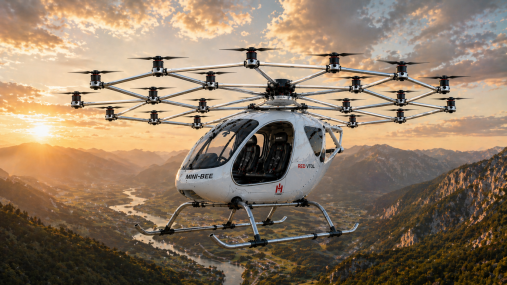
The current reference configuration is the Mini-Bee P2H18: a two-seat hybrid VTOL multicopter using 18 distributed rotors, a Rotax 916 iS thermal engine, twin EMRAX 208 high-voltage electric machines, supercapacitor support and computerized flight control.
Current maturity level: TRL4 – demonstrator stage.
Project Vision
Mini-Bee is not only a VTOL technology demonstrator. It is designed around a mission need: reaching people and equipment in difficult environments where conventional ground access is slow, damaged or unavailable.
Rapid access for a pilot, doctor, operator or stabilized passenger in areas where ground routes are disrupted.
A modular logistics concept based on LD3 air cargo containers and controlled assembly near the mission area.
A practical VTOL demonstrator intended to reduce deployment complexity compared with conventional helicopter logistics.
The project follows an open-innovation approach where academics, industrial partners, independent contributors and humanitarian stakeholders can contribute to the development of a practical VTOL platform.
Reference Configuration – Mini-Bee P2H18

| Parameter | Current reference value |
|---|---|
| Aircraft type | Hybrid VTOL multicopter |
| Configuration | P2H18 – 2 persons on board, 18 rotors |
| Capacity | 1 pilot + 1 passenger or medical operator |
| Propulsion | Rotax 916 iS + 2 × EMRAX 208 HV CC |
| Lift system | 18 distributed vertical-lift rotors |
| Cruise speed | 160 km/h target |
| Target range | 450 km |
| Cruise power | 100 kW target |
| MTOW | 700 kg target |
| Safety approach | Rotor redundancy, ballistic parachute, emergency beacon, computerized flight control |
| Deployment | Modular packing into LD3 containers |
| Maturity | TRL4 – demonstrator stage |
Visual Overview
The following visual library is prepared for the official Mini-Bee image set. The aircraft configuration must remain unchanged: white Mini-Bee fuselage, homogeneous hexagonal upper rotor structure, symmetrical metallic tubular arms, triangulated structure connected to the central hub, and exactly 18 rotors with 18 visible propellers.
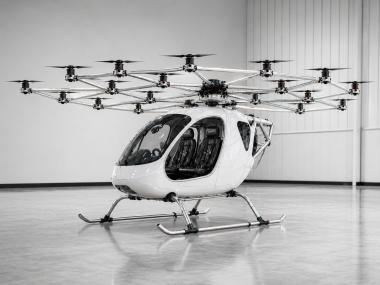
Hero view – humanitarian VTOL concept
Reference product view – P2H18
Hybrid technical architecture
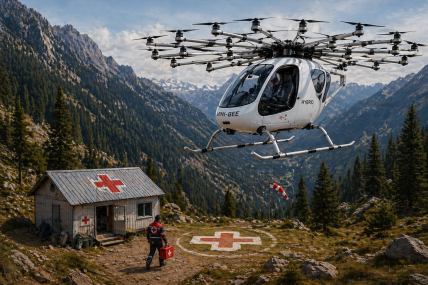
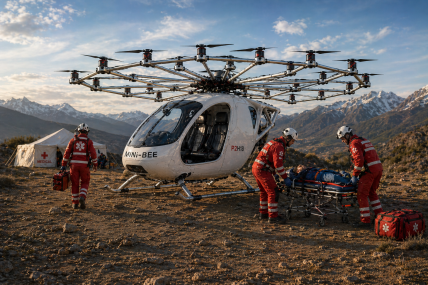
Light air ambulance mission
Disaster relief mission
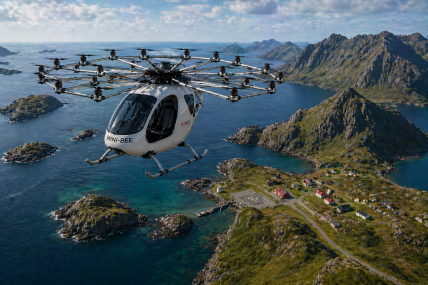
Remote access mission
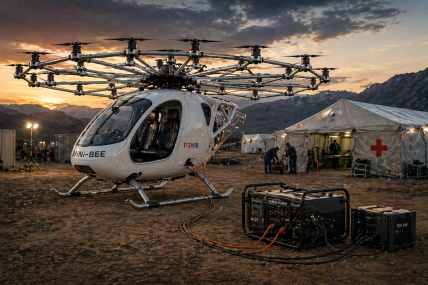
Emergency energy support
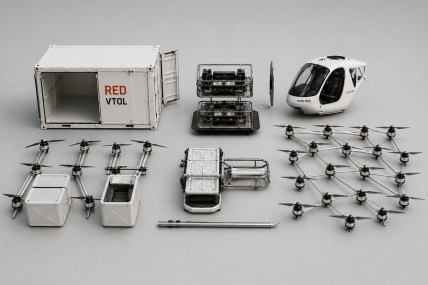
LD3 modular deployment
Cockpit, HMI and avionics
Tarmac assembly


Mission Logic First
The Mini-Bee project follows a mission-first design logic. The aim is not to reproduce an air taxi concept, but to study a practical aircraft for humanitarian and emergency operations.
The aircraft is intended for situations where:
- roads are damaged, slow or unavailable;
- a conventional helicopter is too costly or difficult to deploy;
- a runway is not available;
- rapid access is more important than high cruise speed;
- one pilot and one passenger/operator are sufficient;
- compact logistics and field assembly are essential.
Mini-Bee prioritizes practical access, deployability and emergency usefulness over luxury mobility or high-speed transport.
Core Humanitarian Missions
Why Hybrid Propulsion Matters
A fully electric multicopter can be attractive for short missions, but humanitarian operations often face limited charging infrastructure, uncertain logistics and longer-distance access needs.
Mini-Bee therefore studies a hybrid architecture intended to combine the endurance and practicality of thermal energy with the controllability and redundancy of distributed electric lift.
Hybrid Technical Architecture

| Subsystem | Role |
|---|---|
| Rotax 916 iS | Thermal power source for hybrid generation |
| EMRAX 208 HV CC | Electric machines used in the hybrid power chain |
| Rectifiers | Conversion toward high-voltage DC distribution |
| Supercapacitors | Buffer for transient power demands and emergency support |
| ESC / power controllers | Individual rotor control and thrust distribution |
| 18 rotors | Distributed vertical lift and redundancy studies |
| FCU | Stabilization, flight control, degraded modes and safety logic |
Flight Control Unit and Stabilization
Why a dedicated FCU is needed
Mini-Bee is neither a conventional helicopter nor a battery-only multicopter. The FCU must manage distributed lift, hybrid power behavior, assisted control and degraded modes.
- vertical take-off and landing;
- hover stabilization;
- pitch, roll and yaw control;
- power distribution across 18 rotors;
- STOP mode and emergency logic;
- telemetry and flight data recording.
Current prototyping direction
The current prototyping approach is based on STM32 / Nucleo components and inertial/environmental sensors.
- accelerometers and gyroscopes;
- magnetometer;
- barometric pressure sensor;
- GPS or positioning input;
- power and rotor monitoring.
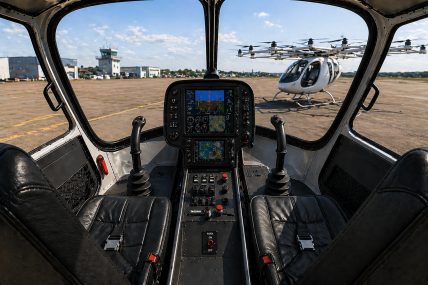
Cockpit, HMI and Avionics

The cockpit concept is designed around simplified assisted flight control.
- one pilot on board;
- joystick-based control;
- sport / assisted mode logic;
- emergency beacon;
- Kanardia EMSIS / DAQu equipment studies;
- clear warning and alarm logic;
- computerized flight assistance.
The aircraft remains a demonstrator. The final cockpit configuration must be validated through HMI studies, simulation, ground tests and future certification-oriented reviews.
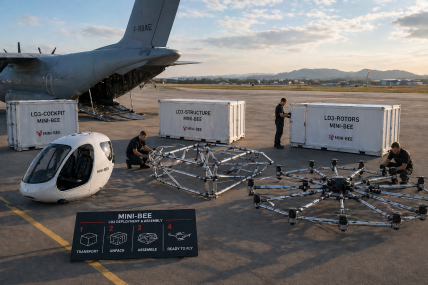
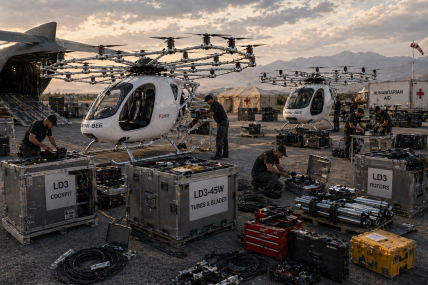
Modular Deployment with LD3 Containers

A major operational goal of Mini-Bee is rapid deployment through standard air cargo logistics.
| Module | Content |
|---|---|
| LD3 – Cockpit | Main cabin, seats, avionics and central structure |
| LD3 – Tubes | Tubular frame, structural arms and assembly elements |
| LD3 – Blades / Rotors | Rotor elements, blades and mission equipment |
Tarmac Assembly

- Air transport by civil cargo aircraft.
- Unloading of LD3 modules.
- Controlled assembly on tarmac.
- Ground checks.
- Propulsion and FCU validation.
- Mission preparation close to the intervention area.
Safety Philosophy
18 rotors for redundancy studies and thrust allocation.
Ballistic parachute, emergency beacon and degraded modes.
Anti-crash seats and structure as central design topics.
A single-engine hybrid multicopter does not follow the same safety logic as a conventional helicopter. For this reason, emergency descent, parachute recovery and rotor redundancy are central design topics.
Certification-Oriented Development

Mini-Bee is currently a TRL4 demonstrator. It is not presented as a certified operational aircraft.
The development approach anticipates certification logic by considering:
- CS-27 small rotorcraft logic;
- SC-VTOL capable aircraft considerations;
- hybrid propulsion compliance topics;
- electric and hybrid propulsion system references;
- EWIS and high-voltage power distribution;
- crashworthiness;
- flight control software and verification;
- requirement compliance matrices.
Collaborative Organization 2025–2026
The Mini-Bee project is collaborative by design. Academic and industrial partners contribute to specific work packages.
| Work package | Main focus | 2025–2026 orientation |
|---|---|---|
| FCU – 18 rotors | Stabilization, rotor allocation, STOP mode, degraded modes | ESTACA Saint-Quentin studies and STM-based prototyping |
| Hybrid power chain | Rotax / EMRAX / rectifier / supercapacitor modeling and tests | Centrale Lille studies and hybrid generation test bench |
| Structure and crashworthiness | Tubular structure, rotor support, crash resistance | ESTACA Bordeaux and Lycée Louis Armand studies |
| Avionics and HMI | Displays, joystick, warning logic, Kanardia integration | ESTACA SQY and Centrale Lille coordination |
| Certification framework | SC-VTOL, CS-27, compliance matrix, test logic | Progressive structuring toward pre-certification |
Roadmap
| Period | Target |
|---|---|
| 2025–2026 | Detailed design, FCU 18-rotor development, Rotax + Kanardia ground tests, hybrid generation tests |
| 2026 | Integrated ground demonstrator with propulsion, FCU and sensors |
| 2027 | Tethered flight prototype target |
| 2028 | First free-flight demonstrator target |
| 2029 | Pre-certification work and SC-VTOL / CS-27 compliance matrix |
Project History
The Mini-Bee project was launched in 2015 to study lightweight personal air transportation and progressively shifted toward medical and humanitarian use cases.
Past project stages include:
Earlier presentations and public project milestones:
- File:20210414 Mini-Bee v10.pdf
- File:20210407 VTOL et Mini-Bee v2.pdf
- File:20230418 Mini-Bee v16.pdf
- File:20240417 Prez Mini Bee ECL.pdf
- File:20251012 Mini-Bee v24.pdf
The 2025 reference configuration updates the project around the P2H18 architecture with 18 distributed rotors, Rotax 916 iS hybrid power, two persons on board and LD3 deployment logic.
Relation with RED VTOL ONG
RED VTOL ONG gives the project a strong humanitarian orientation. The Mini-Bee aircraft concept is studied as a tool for missions where time, access and practical deployment are central.
- reach difficult areas faster;
- transport useful payloads or one additional person;
- support medical intervention;
- reduce dependency on runway infrastructure;
- remain more deployable than a conventional helicopter;
- provide a practical bridge between humanitarian constraints and VTOL technology.
See also:
Current Limitations
Mini-Bee is still in demonstrator stage.
- no certified operational aircraft yet;
- propulsion and FCU integration still under validation;
- structural design and crashworthiness studies still in progress;
- flight envelope not finalized;
- certification basis and means of compliance still under construction;
- mission use cases must remain demonstrator-level until validation.
Links
- Mini-Bee website
- Collaborative Bee Wiki
- Lesser Open Bee License 1.3
- EMRAX electric motors
- Rotax aircraft engines
- Kanardia avionics
- STM32 Nucleo boards
Summary
Mini-Bee is a TRL4 collaborative hybrid VTOL demonstrator designed around urgent humanitarian missions.
The project continues toward an integrated ground demonstrator, tethered flight testing, free-flight demonstration and progressive pre-certification work.