Difference between revisions of "Minibee TRL0"
Wiki.admin (talk | contribs) |
Wiki.admin (talk | contribs) |
||
| Line 1: | Line 1: | ||
| − | {{DISPLAYTITLE:TRL 0 – Mini-Bee}} __TOC__ <div style="border:1px solid #cfd6dd; background:#ffffff; margin-bottom: | + | {{DISPLAYTITLE:TRL 0 – Mini-Bee}} |
| + | |||
| + | __TOC__ | ||
| + | |||
| + | <div style="border:1px solid #cfd6dd; background:#ffffff; margin-bottom:22px;"> | ||
| + | <div style="background:#1f3a5f; color:#ffffff; padding:12px 16px; font-weight:bold; font-size:120%;"> | ||
| + | TRL 0 – Mini-Bee | Concept Origin and Early Intuition | ||
| + | </div> | ||
| + | |||
| + | <div style="padding:16px;"> | ||
| + | {| style="width:100%; border-collapse:collapse;" | ||
| + | |- | ||
| + | | style="width:48%; vertical-align:middle; padding-right:22px;" | | ||
| + | |||
| + | '''TRL 0''' is used on this wiki as an internal archive level for the Mini-Bee project. | ||
| + | |||
| + | It documents the period before the formal Technology Readiness Level scale begins at '''TRL 1 – Basic Principles Observed'''. | ||
| + | |||
| + | This page gathers the first Mini-Bee concept materials: early mission needs, hand sketches, preliminary aircraft assumptions, first sizing logic and early propulsion discussions. | ||
| + | |||
| + | The material presented here is historical. It does not represent the final or current Mini-Bee architecture. Its purpose is to explain how the project started and how the early concept progressively moved toward a hybrid VTOL multicopter approach. | ||
| + | |||
| + | | style="width:52%; vertical-align:middle; text-align:center;" | | ||
| + | [[File:mb_trl0_early_3d_render.png|frameless|520px|Mini-Bee early concept render]] | ||
| + | <div style="color:#4b5563; margin-top:6px;">Early Mini-Bee concept render – historical pre-TRL visual</div> | ||
| + | <div style="margin-top:8px;">[[Media:mb_trl0_early_3d_render.png|Open image]]</div> | ||
| + | |} | ||
| + | </div> | ||
| + | </div> | ||
| + | |||
| + | == Quick project summary == | ||
| + | |||
| + | {| style="width:100%; border-collapse:separate; border-spacing:12px; margin-bottom:20px;" | ||
| + | |- | ||
| + | | style="width:25%; vertical-align:top; border:1px solid #cfd6dd; background:#f6f8fa; padding:12px;" | | ||
| + | '''Project'''<br /> | ||
| + | Mini-Bee | ||
| + | |||
| + | | style="width:25%; vertical-align:top; border:1px solid #cfd6dd; background:#f6f8fa; padding:12px;" | | ||
| + | '''Stage'''<br /> | ||
| + | TRL 0 – Concept origin | ||
| + | |||
| + | | style="width:25%; vertical-align:top; border:1px solid #cfd6dd; background:#f6f8fa; padding:12px;" | | ||
| + | '''Main period'''<br /> | ||
| + | Early concept phase / 2015 archive | ||
| + | |||
| + | | style="width:25%; vertical-align:top; border:1px solid #cfd6dd; background:#f6f8fa; padding:12px;" | | ||
| + | '''Main output'''<br /> | ||
| + | Mission need, sketches, first sizing and early technical assumptions | ||
| + | |} | ||
| + | |||
| + | <div style="border-left:4px solid #1f3a5f; background:#f6f8fa; padding:12px; margin:16px 0;"> | ||
| + | '''Important note:''' TRL 0 is not part of the standard TRL scale. It is used here as a practical archive stage to describe the pre-TRL concept work before TRL 1. | ||
| + | </div> | ||
| + | |||
| + | == Visual introduction == | ||
| + | |||
| + | {| style="width:100%; border-collapse:separate; border-spacing:12px; margin-bottom:22px;" | ||
| + | |- | ||
| + | | style="width:33%; vertical-align:top; border:1px solid #cfd6dd; background:#ffffff; padding:10px; text-align:center;" | | ||
| + | [[File:mb_trl0_early_3d_render.png|frameless|300px|Early Mini-Bee digital concept]] | ||
| + | <div style="margin-top:8px;">'''Early digital concept'''</div> | ||
| + | <div style="color:#4b5563;">First communication-style view of the Mini-Bee idea.</div> | ||
| + | <div style="margin-top:8px;">[[Media:mb_trl0_early_3d_render.png|Open image]]</div> | ||
| + | |||
| + | | style="width:33%; vertical-align:top; border:1px solid #cfd6dd; background:#ffffff; padding:10px; text-align:center;" | | ||
| + | [[File:mb_trl0_hand_sketch_01.png|frameless|300px|Mini-Bee first hand sketch]] | ||
| + | <div style="margin-top:8px;">'''First hand sketches'''</div> | ||
| + | <div style="color:#4b5563;">Initial side, front and top views used to explore aircraft layout.</div> | ||
| + | <div style="margin-top:8px;">[[Media:mb_trl0_hand_sketch_01.png|Open image]]</div> | ||
| + | |||
| + | | style="width:33%; vertical-align:top; border:1px solid #cfd6dd; background:#ffffff; padding:10px; text-align:center;" | | ||
| + | [[File:mb_trl0_supmeca_report_cover.png|frameless|300px|Mini-Bee early SUPMECA report]] | ||
| + | <div style="margin-top:8px;">'''Early project report'''</div> | ||
| + | <div style="color:#4b5563;">2015 concept report documenting the first mission and design logic.</div> | ||
| + | <div style="margin-top:8px;">[[Media:mb_trl0_supmeca_report_cover.png|Open image]]</div> | ||
| + | |} | ||
| + | |||
| + | == Project overview == | ||
| + | |||
| + | The '''Mini-Bee''' concept started from a simple operational question: could a compact aircraft combine vertical take-off capability, practical mobility, hybrid propulsion and useful mission applications? | ||
| + | |||
| + | At this early stage, the project was not yet a validated technical architecture. It was an exploration phase. | ||
| + | |||
| + | The objective was to study whether an aircraft could combine some of the operational flexibility of a helicopter with a simpler, more affordable and more adaptable configuration. | ||
| + | |||
| + | The first studies considered a hybrid aircraft using electric propulsion for VTOL phases and a thermal engine for cruise power or onboard electrical generation. These assumptions were later refined through the following TRL stages. | ||
| + | |||
| + | == Concept origin == | ||
| + | |||
| + | The early Mini-Bee idea was driven by several mission and design needs: | ||
| + | |||
| + | * provide high mobility without depending only on conventional runways; | ||
| + | * explore a low-cost aircraft concept; | ||
| + | * support practical missions such as air ambulance, rescue, emerging-country mobility and personal transportation; | ||
| + | * combine vertical take-off and landing with cruise flight capability; | ||
| + | * investigate hybrid propulsion; | ||
| + | * reduce the dependency on large battery capacity by using a thermal power source; | ||
| + | * prepare a technical basis for future student projects, design work and demonstrator studies. | ||
| + | |||
| + | == Early mission framing == | ||
| + | |||
| + | {| style="width:100%; border-collapse:separate; border-spacing:12px; margin:16px 0;" | ||
| + | |- | ||
| + | | style="width:33%; vertical-align:top; border:1px solid #cfd6dd; background:#ffffff; padding:12px;" | | ||
| + | '''Mobility''' | ||
| + | |||
| + | The concept aimed to operate from many types of locations, not only from conventional runways. | ||
| + | |||
| + | | style="width:33%; vertical-align:top; border:1px solid #cfd6dd; background:#ffffff; padding:12px;" | | ||
| + | '''Low cost''' | ||
| + | |||
| + | The early requirement logic included a strong cost objective to make the aircraft accessible and useful. | ||
| + | |||
| + | | style="width:33%; vertical-align:top; border:1px solid #cfd6dd; background:#ffffff; padding:12px;" | | ||
| + | '''Useful missions''' | ||
| + | |||
| + | The first project logic included rescue missions, air ambulance use cases and low-cost personal transportation. | ||
| + | |} | ||
| + | |||
| + | == Historical early assumptions == | ||
| + | |||
| + | {| class="wikitable" style="width:100%;" | ||
| + | |- | ||
| + | ! style="width:35%; background:#eef1f4;" | Early assumption | ||
| + | ! style="background:#eef1f4;" | Historical interpretation at TRL 0 | ||
| + | |- | ||
| + | | '''Hybrid configuration''' | ||
| + | | Electric motors would support VTOL phases, while a thermal engine would provide cruise power and/or electrical generation. | ||
| + | |- | ||
| + | | '''VTOL capability''' | ||
| + | | Vertical take-off and landing were identified as a key differentiator for high mobility. | ||
| + | |- | ||
| + | | '''Cruise speed''' | ||
| + | | Early objectives mentioned a high cruise speed target around 300 ± 50 km/h. | ||
| + | |- | ||
| + | | '''Range''' | ||
| + | | Early objectives mentioned an autonomy target between 600 and 800 km. | ||
| + | |- | ||
| + | | '''Mass and capacity''' | ||
| + | | Early studies considered a larger aircraft concept, including 4 or 5 seats and an MTOW around 1550 kg. | ||
| + | |- | ||
| + | | '''Cost target''' | ||
| + | | Early requirements mentioned a low-cost objective below 100,000 €. | ||
| + | |} | ||
| + | |||
| + | <div style="border:1px solid #cfd6dd; background:#f6f8fa; padding:12px; margin:16px 0;"> | ||
| + | '''Historical note:''' these assumptions belong to the pre-TRL concept phase. They are not the current Mini-Bee configuration. | ||
| + | </div> | ||
| + | |||
| + | == First hand sketches == | ||
| + | |||
| + | The first hand sketches helped define the initial visual intuition of the aircraft. | ||
| + | |||
| + | They explored the side view, the front view, the top view and early layout alternatives. At this stage, the aim was not to freeze the design, but to make the concept visible enough to start technical discussions. | ||
| + | |||
| + | <gallery mode="packed" heights="180"> | ||
| + | File:mb_trl0_hand_sketch_01.png|Initial sketch sheet – first layout intuition | ||
| + | File:mb_trl0_hand_sketch_02.png|Alternative early configuration | ||
| + | File:mb_trl0_hand_sketch_03.png|Early layout refinement | ||
| + | </gallery> | ||
| + | |||
| + | == Early digital concept == | ||
| + | |||
| + | The early digital concept was used as a communication visual. It helped present the Mini-Bee idea as a possible hybrid VTOL aircraft before the project reached a mature architecture. | ||
| + | |||
| + | <div style="border:1px solid #cfd6dd; background:#ffffff; padding:12px; margin:16px 0; text-align:center;"> | ||
| + | [[File:mb_trl0_early_3d_render.png|frameless|760px|Mini-Bee early digital concept render]] | ||
| + | <div style="color:#4b5563; margin-top:6px;">Historical early Mini-Bee digital concept render</div> | ||
| + | <div style="margin-top:8px;">[[Media:mb_trl0_early_3d_render.png|Open image]]</div> | ||
| + | </div> | ||
| + | |||
| + | == Preliminary technical studies == | ||
| + | |||
| + | TRL 0 included early analytical work to check whether the first aircraft intuition could become a credible project direction. | ||
| + | |||
| + | The purpose was not to validate a final design. The purpose was to identify the first technical constraints: lift, mass, power, propulsion, autonomy and operational use. | ||
| + | |||
| + | {| style="width:100%; border-collapse:separate; border-spacing:12px; margin:16px 0;" | ||
| + | |- | ||
| + | | style="width:33%; vertical-align:top; border:1px solid #cfd6dd; background:#ffffff; padding:12px;" | | ||
| + | '''Wing sizing intuition''' | ||
| + | |||
| + | An initial wing chord evaluation explored the relationship between wingspan, stall speed, lift and wing chord. | ||
| + | |||
| + | | style="width:33%; vertical-align:top; border:1px solid #cfd6dd; background:#ffffff; padding:12px;" | | ||
| + | '''Thermal engine search''' | ||
| + | |||
| + | A first engine study examined the possible role of a thermal engine in a hybrid aircraft power architecture. | ||
| + | |||
| + | | style="width:33%; vertical-align:top; border:1px solid #cfd6dd; background:#ffffff; padding:12px;" | | ||
| + | '''Electric propulsion screening''' | ||
| + | |||
| + | Early electric motor comparisons helped identify the challenge of VTOL power-to-weight ratio. | ||
| + | |} | ||
| + | |||
| + | == Wing chord evaluation == | ||
| + | |||
| + | The initial wing evaluation used a simple aerodynamic approach to estimate the chord needed for different stall speed assumptions. | ||
| + | |||
| + | This work helped transform the early visual idea into a first sizing discussion. | ||
| + | |||
| + | <gallery mode="packed" heights="220"> | ||
| + | File:mb_trl0_wing_chord_eval_01.png|Initial wing chord evaluation – method and assumptions | ||
| + | File:mb_trl0_wing_chord_eval_02.png|Initial wing chord evaluation – results table | ||
| + | </gallery> | ||
| + | |||
| + | == Engine and electric motor evaluation == | ||
| + | |||
| + | The early propulsion work explored two complementary questions. | ||
| + | |||
| + | First, the thermal engine could potentially support cruise power or electrical generation. Second, the electric motors had to be assessed against the demanding power-to-weight requirements of VTOL flight. | ||
| + | |||
| + | <gallery mode="packed" heights="220"> | ||
| + | File:mb_trl0_engine_thermal.png|Thermal engine evaluation | ||
| + | File:mb_trl0_engine_electric_motors.png|Electric motor comparison | ||
| + | </gallery> | ||
| + | |||
| + | == Early requirement table == | ||
| + | |||
| + | The early requirement table helped structure the first mission needs and technical constraints. | ||
| + | |||
| + | It grouped the first expectations related to speed, range, cost, capacity and aircraft usability. | ||
| + | |||
| + | <div style="border:1px solid #cfd6dd; background:#ffffff; padding:12px; margin:16px 0; text-align:center;"> | ||
| + | [[File:mb_trl0_project_requirements.png|frameless|620px|Mini-Bee early requirements table]] | ||
| + | <div style="color:#4b5563; margin-top:6px;">Early Mini-Bee requirement table – historical concept phase</div> | ||
| + | <div style="margin-top:8px;">[[Media:mb_trl0_project_requirements.png|Open image]]</div> | ||
| + | </div> | ||
| + | |||
| + | == What TRL 0 covered == | ||
| + | |||
| + | {| style="width:100%; border-collapse:separate; border-spacing:12px; margin:16px 0;" | ||
| + | |- | ||
| + | | style="width:50%; vertical-align:top; border:1px solid #cfd6dd; background:#f6f8fa; padding:12px;" | | ||
| + | '''Covered at TRL 0''' | ||
| + | |||
| + | * first project intuition; | ||
| + | * mission need exploration; | ||
| + | * low-cost and high-mobility ambition; | ||
| + | * first hand sketches; | ||
| + | * first 3D concept visual; | ||
| + | * initial mission and requirement framing; | ||
| + | * early wing sizing study; | ||
| + | * early propulsion screening; | ||
| + | * early hybrid VTOL assumptions. | ||
| + | |||
| + | | style="width:50%; vertical-align:top; border:1px solid #cfd6dd; background:#f6f8fa; padding:12px;" | | ||
| + | '''Not yet covered at TRL 0''' | ||
| + | |||
| + | * validated aircraft architecture; | ||
| + | * final rotor count; | ||
| + | * mature hybrid propulsion chain; | ||
| + | * detailed structural design; | ||
| + | * flight control architecture; | ||
| + | * certification framework; | ||
| + | * demonstrator test plan; | ||
| + | * validated performance data. | ||
| + | |} | ||
| + | |||
| + | == TRL 0 development logic == | ||
| + | |||
| + | The TRL 0 phase created the project foundation before entering the formal TRL logic. | ||
| + | |||
| + | {| style="width:100%; border-collapse:collapse; text-align:center; margin:16px 0 20px 0;" | ||
| + | |- | ||
| + | | style="background:#1f3a5f; color:#ffffff; border:1px solid #cfd6dd; padding:10px; font-weight:bold;" | 1. Imagine | ||
| + | | style="background:#f3f5f7; border:1px solid #cfd6dd; padding:10px; font-weight:bold;" | 2. Sketch | ||
| + | | style="background:#f3f5f7; border:1px solid #cfd6dd; padding:10px; font-weight:bold;" | 3. Frame | ||
| + | | style="background:#f3f5f7; border:1px solid #cfd6dd; padding:10px; font-weight:bold;" | 4. Screen | ||
| + | | style="background:#f3f5f7; border:1px solid #cfd6dd; padding:10px; font-weight:bold;" | 5. Prepare TRL 1 | ||
| + | |- | ||
| + | | style="border:1px solid #cfd6dd; padding:8px;" | Mission intuition | ||
| + | | style="border:1px solid #cfd6dd; padding:8px;" | Hand sketches and early visuals | ||
| + | | style="border:1px solid #cfd6dd; padding:8px;" | Needs and constraints | ||
| + | | style="border:1px solid #cfd6dd; padding:8px;" | First technical evaluations | ||
| + | | style="border:1px solid #cfd6dd; padding:8px;" | Basic principles observed | ||
| + | |} | ||
| + | |||
| + | == Why TRL 0 mattered == | ||
| + | |||
| + | TRL 0 mattered because it captured the first project intuition before any formal technical maturity could be claimed. | ||
| + | |||
| + | It helped transform an idea into a project direction: a hybrid aircraft with VTOL capability, useful missions, high mobility and a need for technical validation. | ||
| + | |||
| + | This stage prepared the transition toward TRL 1, where the first basic principles of the Mini-Bee concept could be identified and documented. | ||
| + | |||
| + | == Source documents == | ||
| + | |||
| + | {| class="wikitable" style="width:100%;" | ||
| + | |- | ||
| + | ! style="width:40%; background:#eef1f4;" | Document | ||
| + | ! style="background:#eef1f4;" | Use in TRL 0 page | ||
| + | |- | ||
| + | | [[File:MiniBee_HandScketch.pdf]] | ||
| + | | First hand sketches and early visual layout studies. | ||
| + | |- | ||
| + | | [[File:Initial Evaluation of MiniBee.pdf]] | ||
| + | | Initial wing chord evaluation and first sizing assumptions. | ||
| + | |- | ||
| + | | [[File:Engine Repport.pdf]] | ||
| + | | Thermal engine and electric motor screening. | ||
| + | |- | ||
| + | | [[File:BeePlane Info_v1.1.pdf]] | ||
| + | | Early mission statement, requirements, diagrams and project framing. | ||
| + | |} | ||
| + | |||
| + | == Image files used on this page == | ||
| + | |||
| + | {| class="wikitable" style="width:100%;" | ||
| + | |- | ||
| + | ! style="width:40%; background:#eef1f4;" | Wiki file name | ||
| + | ! style="width:30%; background:#eef1f4;" | Use in page | ||
| + | ! style="background:#eef1f4;" | Link | ||
| + | |- | ||
| + | | mb_trl0_early_3d_render.png | ||
| + | | Hero image, visual introduction and early digital concept | ||
| + | | [[Media:mb_trl0_early_3d_render.png|Open image]] | ||
| + | |- | ||
| + | | mb_trl0_hand_sketch_01.png | ||
| + | | Visual introduction and sketch gallery | ||
| + | | [[Media:mb_trl0_hand_sketch_01.png|Open image]] | ||
| + | |- | ||
| + | | mb_trl0_hand_sketch_02.png | ||
| + | | Sketch gallery | ||
| + | | [[Media:mb_trl0_hand_sketch_02.png|Open image]] | ||
| + | |- | ||
| + | | mb_trl0_hand_sketch_03.png | ||
| + | | Sketch gallery | ||
| + | | [[Media:mb_trl0_hand_sketch_03.png|Open image]] | ||
| + | |- | ||
| + | | mb_trl0_wing_chord_eval_01.png | ||
| + | | Wing chord evaluation | ||
| + | | [[Media:mb_trl0_wing_chord_eval_01.png|Open image]] | ||
| + | |- | ||
| + | | mb_trl0_wing_chord_eval_02.png | ||
| + | | Wing chord evaluation | ||
| + | | [[Media:mb_trl0_wing_chord_eval_02.png|Open image]] | ||
| + | |- | ||
| + | | mb_trl0_engine_thermal.png | ||
| + | | Thermal engine evaluation | ||
| + | | [[Media:mb_trl0_engine_thermal.png|Open image]] | ||
| + | |- | ||
| + | | mb_trl0_engine_electric_motors.png | ||
| + | | Electric motor evaluation | ||
| + | | [[Media:mb_trl0_engine_electric_motors.png|Open image]] | ||
| + | |- | ||
| + | | mb_trl0_supmeca_report_cover.png | ||
| + | | Visual introduction and early project report | ||
| + | | [[Media:mb_trl0_supmeca_report_cover.png|Open image]] | ||
| + | |- | ||
| + | | mb_trl0_project_requirements.png | ||
| + | | Early requirement table | ||
| + | | [[Media:mb_trl0_project_requirements.png|Open image]] | ||
| + | |} | ||
| + | |||
| + | == Transition to the next stage == | ||
| + | |||
| + | <div style="border:1px solid #cfd6dd; background:#f6f8fa; padding:14px; margin-top:16px;"> | ||
| + | '''Next maturity step:''' TRL 1 – Basic Principles Observed. | ||
| + | </div> | ||
| + | |||
| + | At TRL 1, the project moves from early intuition and exploratory material toward the identification of basic principles that justify a structured concept phase. | ||
| + | |||
| + | == See also == | ||
| + | |||
| + | * [[Minibee TRL1|TRL 1 – Mini-Bee]] | ||
| + | * [[Minibee TRL2|TRL 2 – Mini-Bee]] | ||
| + | * [[Minibee TRL3|TRL 3 – Mini-Bee]] | ||
| + | * [[Minibee TRL4|TRL 4 – Mini-Bee]] | ||
| + | * [[Mini-Bee|Mini-Bee project]] | ||
| + | * [[Collaborative Bee Projects]] | ||
| + | |||
| + | [[Category:MiniBee]] | ||
| + | [[Category:Mini-Bee]] | ||
| + | [[Category:Technology Readiness Levels]] | ||
| + | [[Category:TRL0]] | ||
| + | [[Category:Collaborative Bee]] | ||
Revision as of 15:58, 12 May 2026
TRL 0 – Mini-Bee | Concept Origin and Early Intuition
|
TRL 0 is used on this wiki as an internal archive level for the Mini-Bee project. It documents the period before the formal Technology Readiness Level scale begins at TRL 1 – Basic Principles Observed. This page gathers the first Mini-Bee concept materials: early mission needs, hand sketches, preliminary aircraft assumptions, first sizing logic and early propulsion discussions. The material presented here is historical. It does not represent the final or current Mini-Bee architecture. Its purpose is to explain how the project started and how the early concept progressively moved toward a hybrid VTOL multicopter approach. |
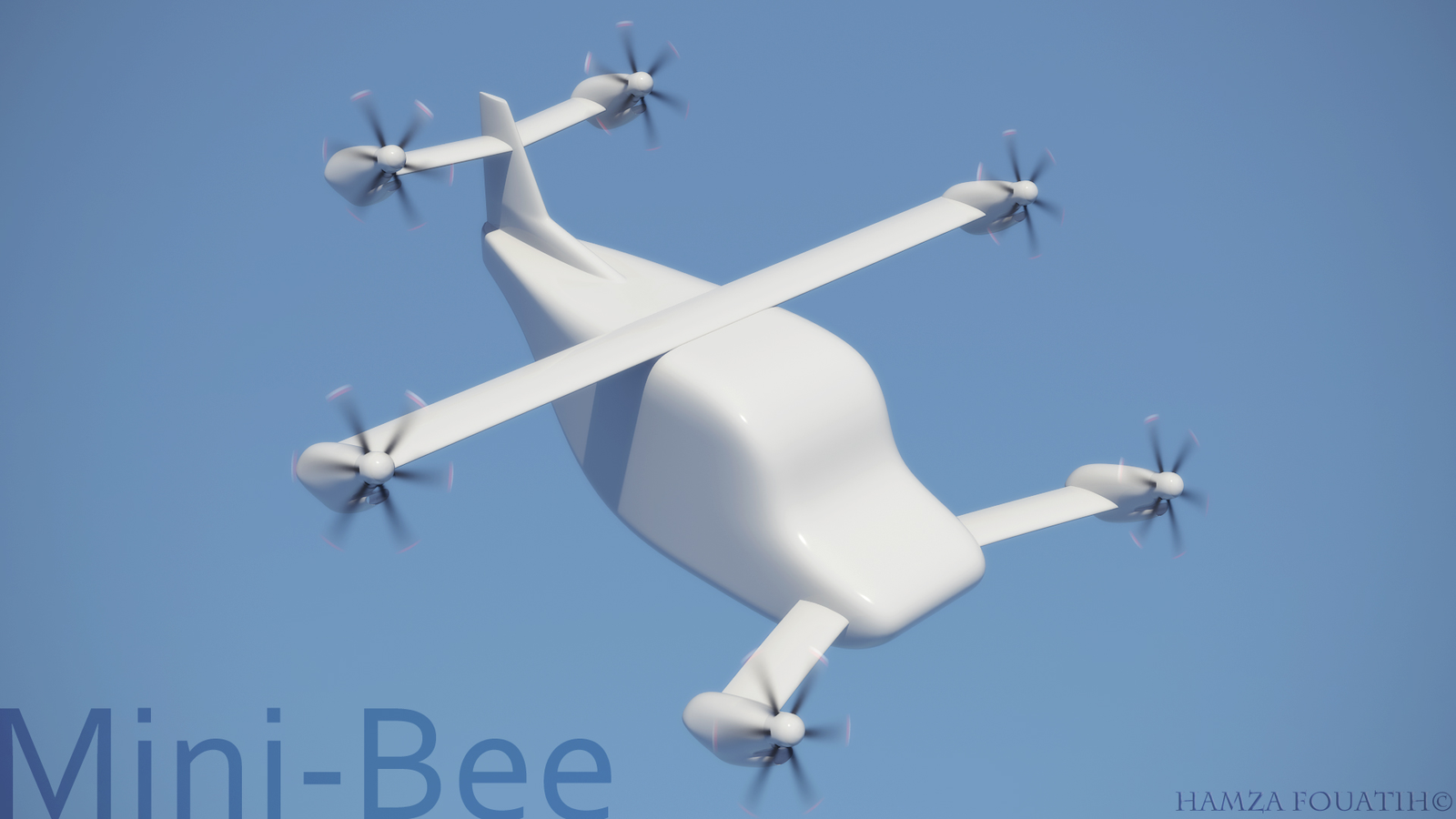
Early Mini-Bee concept render – historical pre-TRL visual
|

Quick project summary
|
Project |
Stage |
Main period |
Main output |
Important note: TRL 0 is not part of the standard TRL scale. It is used here as a practical archive stage to describe the pre-TRL concept work before TRL 1.
Visual introduction
|
Early digital concept
First communication-style view of the Mini-Bee idea.
|
First hand sketches
Initial side, front and top views used to explore aircraft layout.
|
Early project report
2015 concept report documenting the first mission and design logic.
|


Project overview
The Mini-Bee concept started from a simple operational question: could a compact aircraft combine vertical take-off capability, practical mobility, hybrid propulsion and useful mission applications?
At this early stage, the project was not yet a validated technical architecture. It was an exploration phase.
The objective was to study whether an aircraft could combine some of the operational flexibility of a helicopter with a simpler, more affordable and more adaptable configuration.
The first studies considered a hybrid aircraft using electric propulsion for VTOL phases and a thermal engine for cruise power or onboard electrical generation. These assumptions were later refined through the following TRL stages.
Concept origin
The early Mini-Bee idea was driven by several mission and design needs:
- provide high mobility without depending only on conventional runways;
- explore a low-cost aircraft concept;
- support practical missions such as air ambulance, rescue, emerging-country mobility and personal transportation;
- combine vertical take-off and landing with cruise flight capability;
- investigate hybrid propulsion;
- reduce the dependency on large battery capacity by using a thermal power source;
- prepare a technical basis for future student projects, design work and demonstrator studies.
Early mission framing
|
Mobility The concept aimed to operate from many types of locations, not only from conventional runways. |
Low cost The early requirement logic included a strong cost objective to make the aircraft accessible and useful. |
Useful missions The first project logic included rescue missions, air ambulance use cases and low-cost personal transportation. |
Historical early assumptions
| Early assumption | Historical interpretation at TRL 0 |
|---|---|
| Hybrid configuration | Electric motors would support VTOL phases, while a thermal engine would provide cruise power and/or electrical generation. |
| VTOL capability | Vertical take-off and landing were identified as a key differentiator for high mobility. |
| Cruise speed | Early objectives mentioned a high cruise speed target around 300 ± 50 km/h. |
| Range | Early objectives mentioned an autonomy target between 600 and 800 km. |
| Mass and capacity | Early studies considered a larger aircraft concept, including 4 or 5 seats and an MTOW around 1550 kg. |
| Cost target | Early requirements mentioned a low-cost objective below 100,000 €. |
Historical note: these assumptions belong to the pre-TRL concept phase. They are not the current Mini-Bee configuration.
First hand sketches
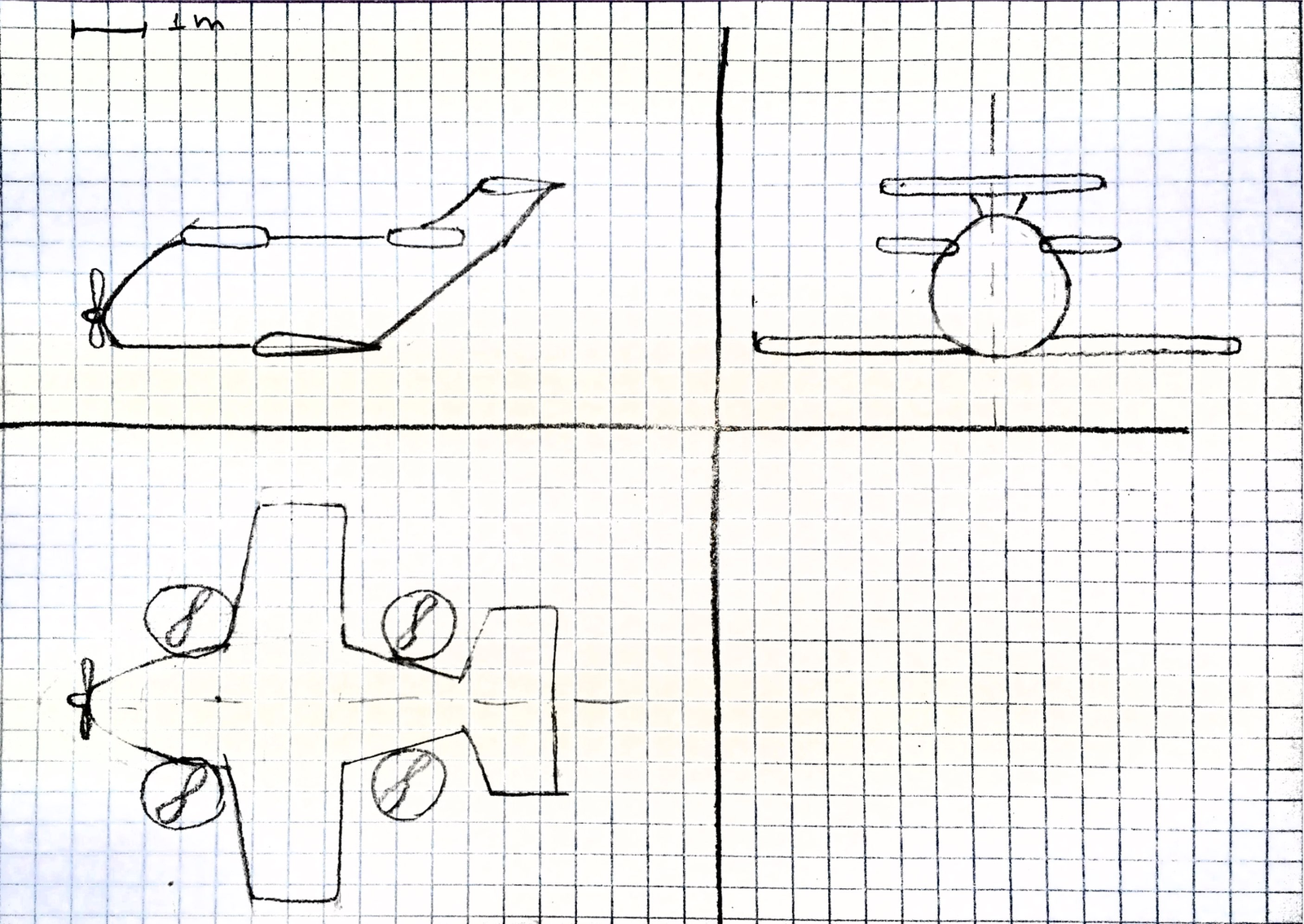
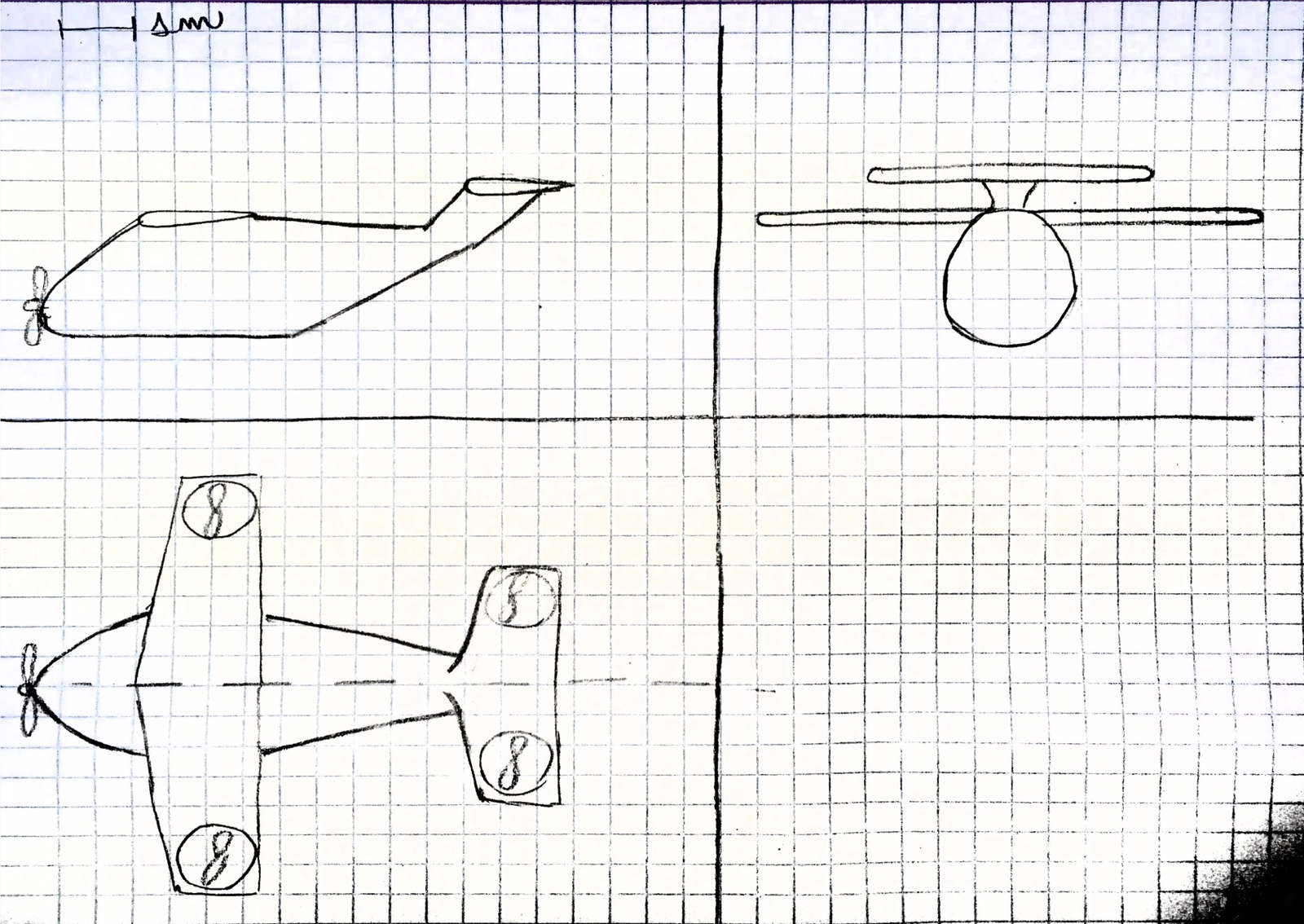
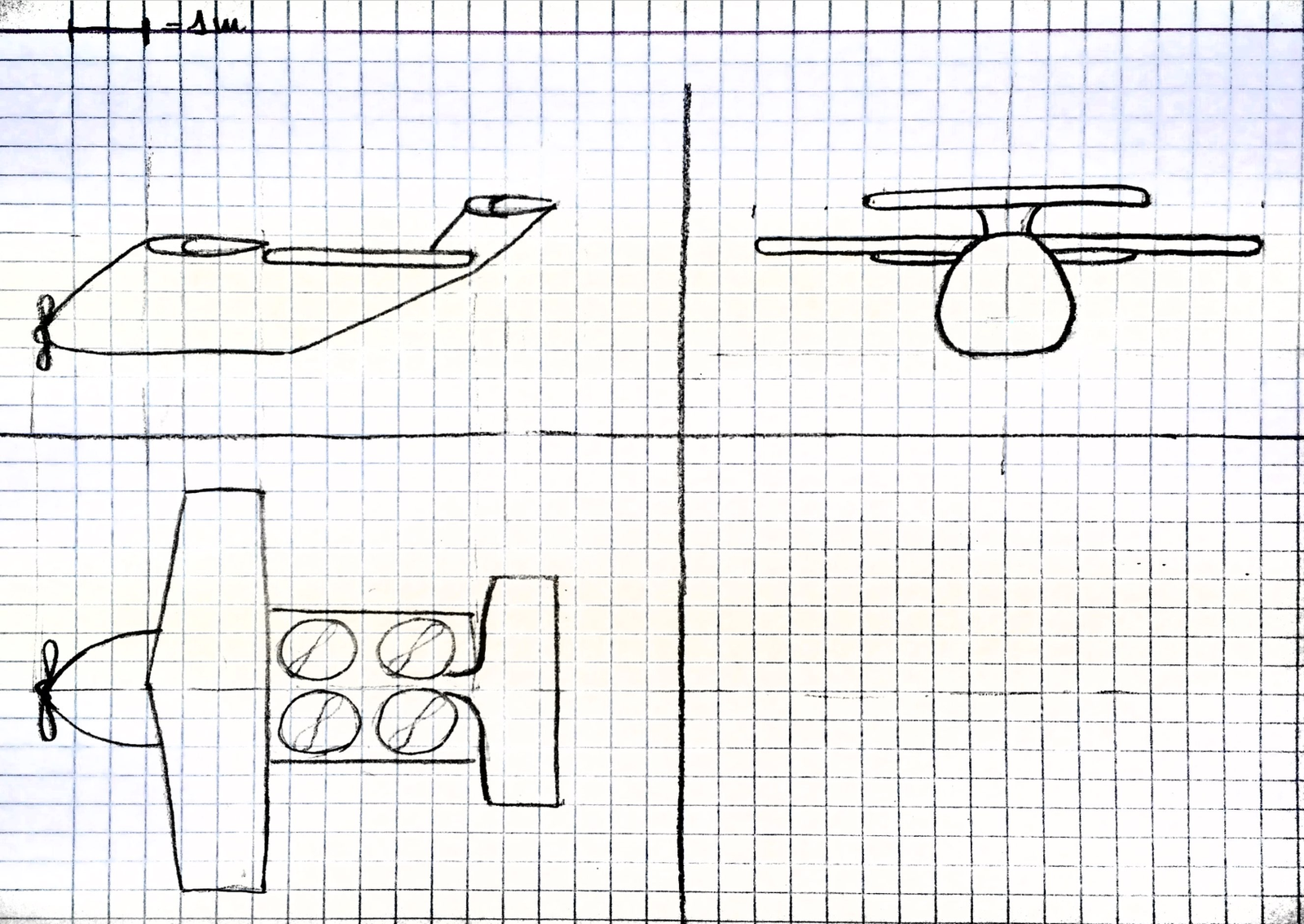
The first hand sketches helped define the initial visual intuition of the aircraft.
They explored the side view, the front view, the top view and early layout alternatives. At this stage, the aim was not to freeze the design, but to make the concept visible enough to start technical discussions.
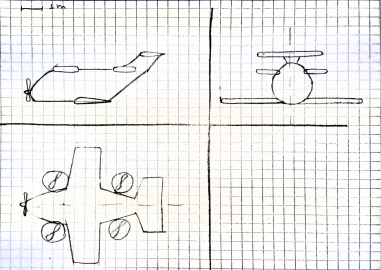
Initial sketch sheet – first layout intuition
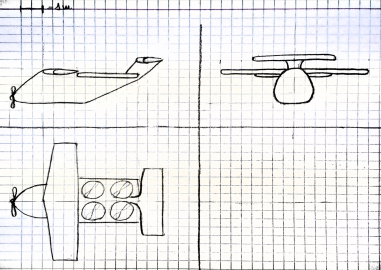
Alternative early configuration
Early layout refinement


Early digital concept
The early digital concept was used as a communication visual. It helped present the Mini-Bee idea as a possible hybrid VTOL aircraft before the project reached a mature architecture.
Preliminary technical studies
TRL 0 included early analytical work to check whether the first aircraft intuition could become a credible project direction.
The purpose was not to validate a final design. The purpose was to identify the first technical constraints: lift, mass, power, propulsion, autonomy and operational use.
|
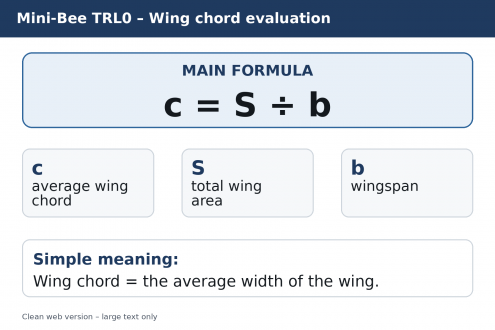
Wing sizing intuition An initial wing chord evaluation explored the relationship between wingspan, stall speed, lift and wing chord. |
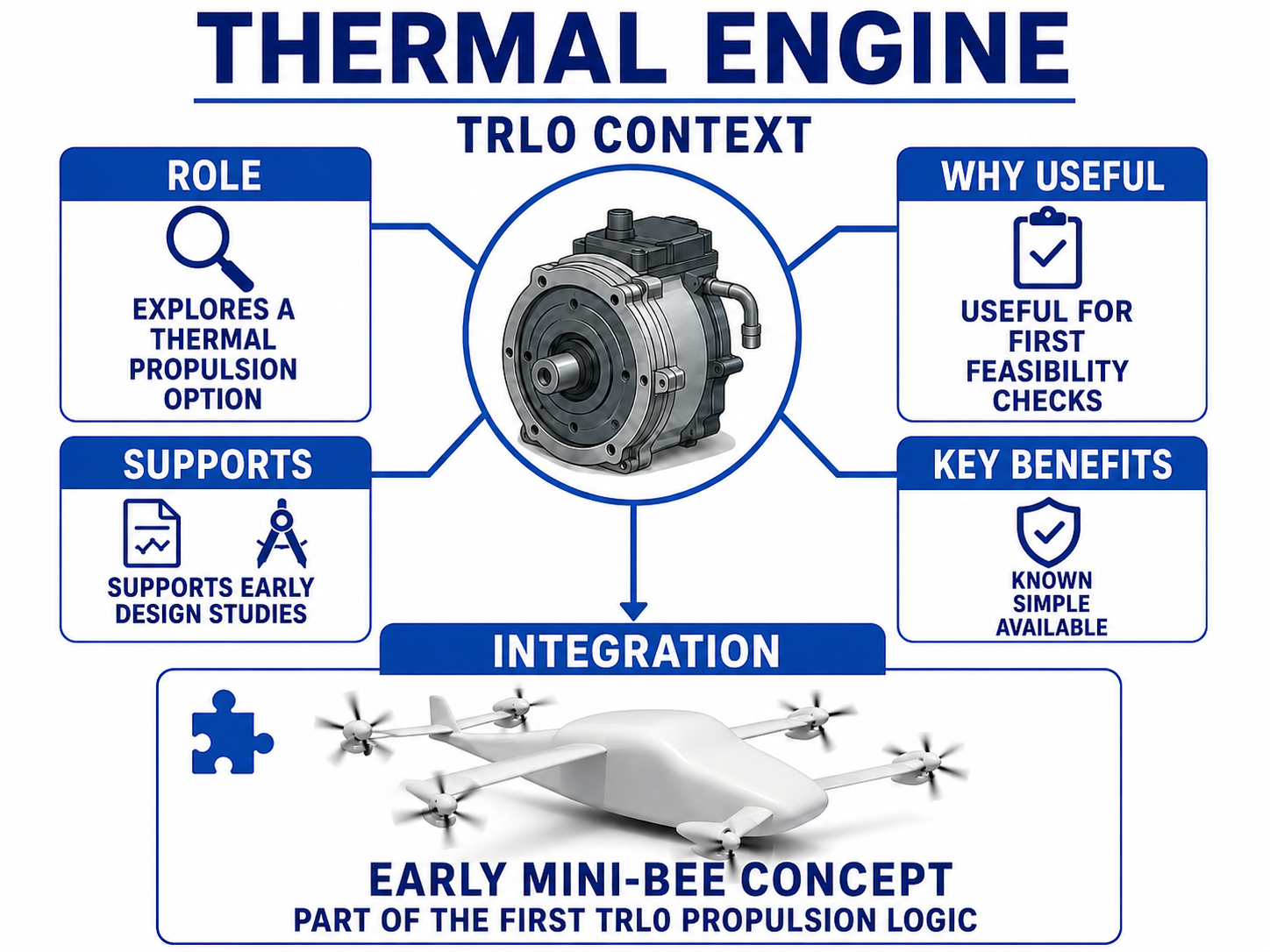
Thermal engine search A first engine study examined the possible role of a thermal engine in a hybrid aircraft power architecture. |
Electric propulsion screening Early electric motor comparisons helped identify the challenge of VTOL power-to-weight ratio. |
Wing chord evaluation
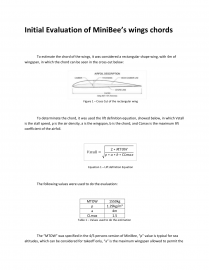
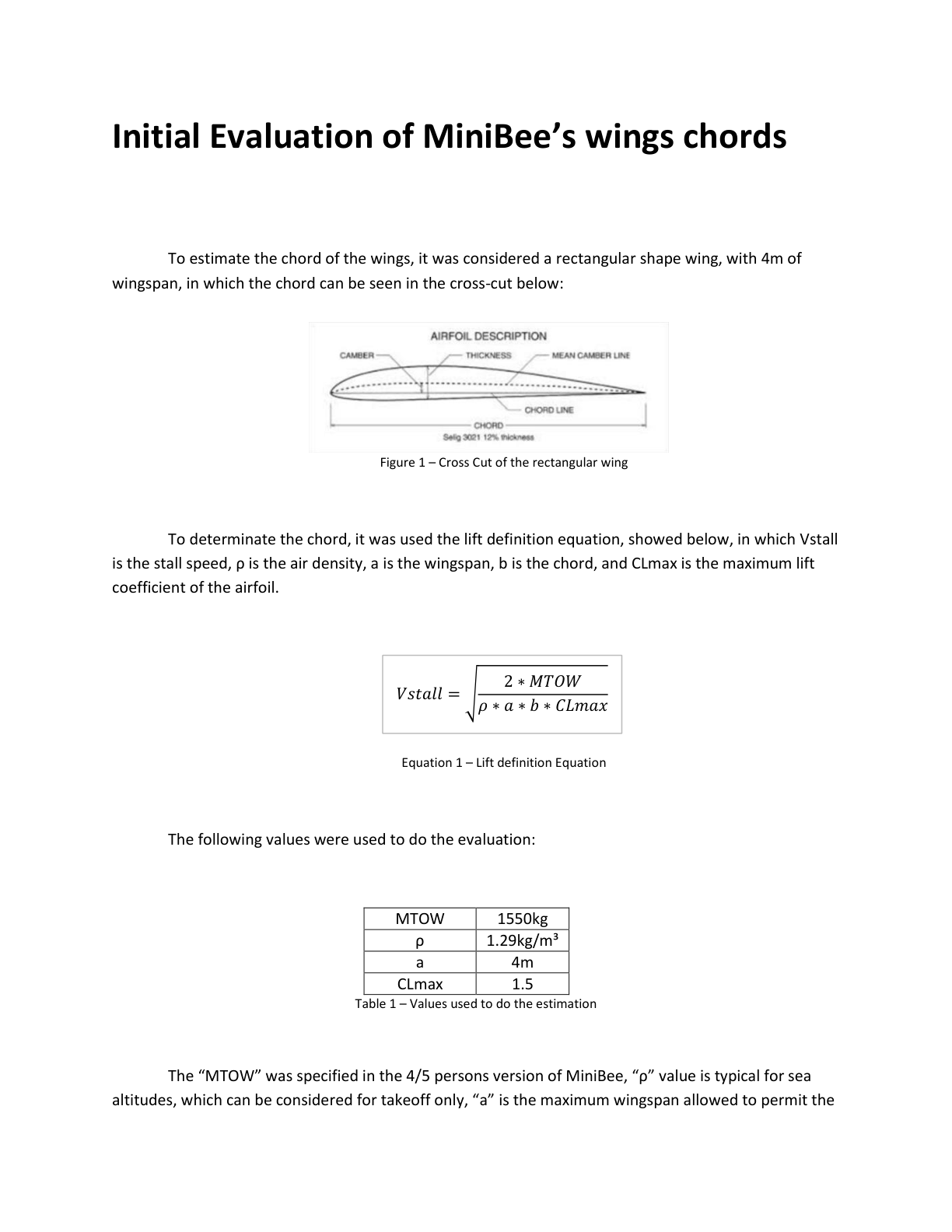
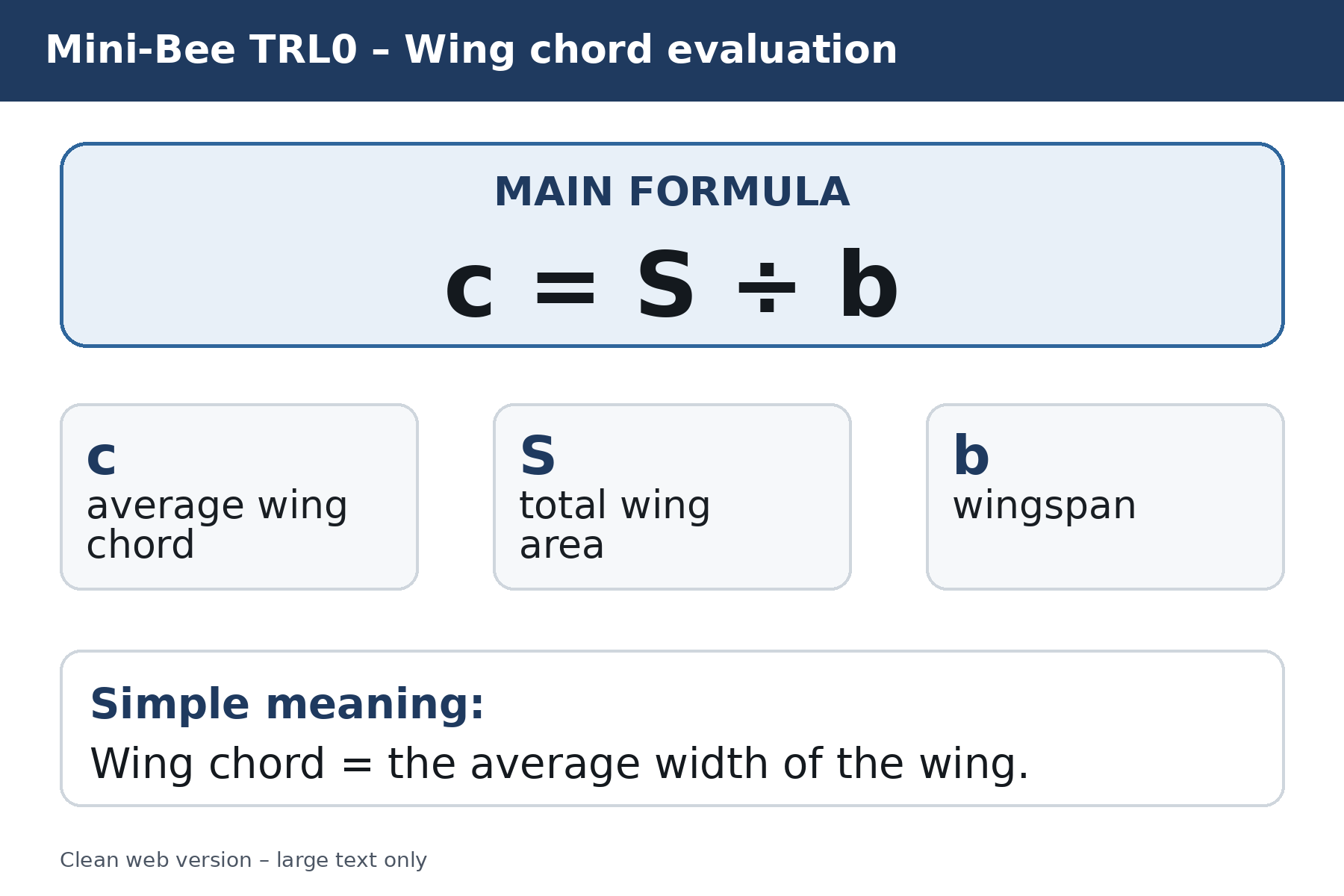
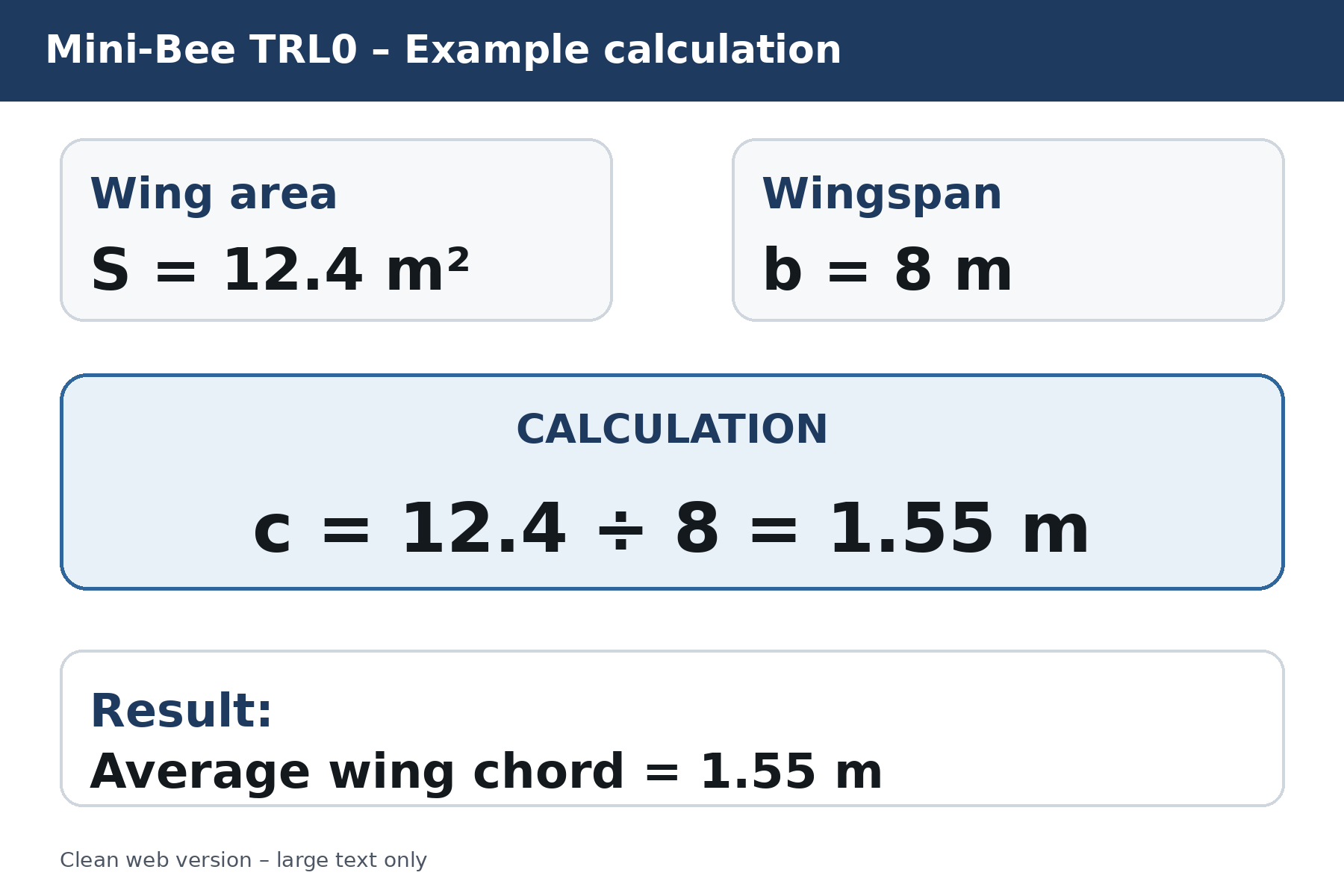
The initial wing evaluation used a simple aerodynamic approach to estimate the chord needed for different stall speed assumptions.
This work helped transform the early visual idea into a first sizing discussion.
Initial wing chord evaluation – method and assumptions
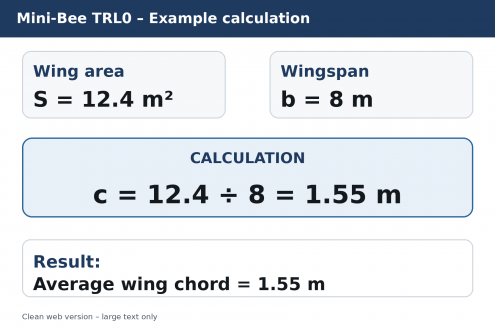
Initial wing chord evaluation – results table


Engine and electric motor evaluation
The early propulsion work explored two complementary questions.
First, the thermal engine could potentially support cruise power or electrical generation. Second, the electric motors had to be assessed against the demanding power-to-weight requirements of VTOL flight.
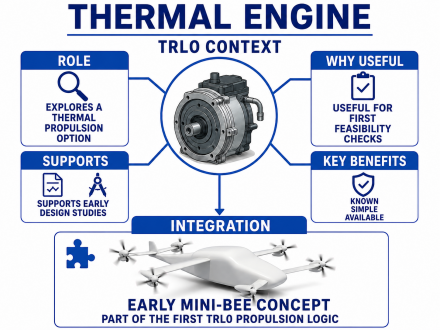
Thermal engine evaluation
- Mb trl0 engine electric motors.png
Electric motor comparison

Early requirement table
The early requirement table helped structure the first mission needs and technical constraints.
It grouped the first expectations related to speed, range, cost, capacity and aircraft usability.
Mini-Bee early requirements table

What TRL 0 covered
|
Covered at TRL 0
|
Not yet covered at TRL 0
|
TRL 0 development logic
The TRL 0 phase created the project foundation before entering the formal TRL logic.
| 1. Imagine | 2. Sketch | 3. Frame | 4. Screen | 5. Prepare TRL 1 |
| Mission intuition | Hand sketches and early visuals | Needs and constraints | First technical evaluations | Basic principles observed |
Why TRL 0 mattered
TRL 0 mattered because it captured the first project intuition before any formal technical maturity could be claimed.
It helped transform an idea into a project direction: a hybrid aircraft with VTOL capability, useful missions, high mobility and a need for technical validation.
This stage prepared the transition toward TRL 1, where the first basic principles of the Mini-Bee concept could be identified and documented.
Source documents
| Document | Use in TRL 0 page |
|---|---|
| File:MiniBee HandScketch.pdf | First hand sketches and early visual layout studies. |
| File:Initial Evaluation of MiniBee.pdf | Initial wing chord evaluation and first sizing assumptions. |
| File:Engine Repport.pdf | Thermal engine and electric motor screening. |
| File:BeePlane Info v1.1.pdf | Early mission statement, requirements, diagrams and project framing. |
Image files used on this page
| Wiki file name | Use in page | Link |
|---|---|---|
| mb_trl0_early_3d_render.png | Hero image, visual introduction and early digital concept | Open image |
| mb_trl0_hand_sketch_01.png | Visual introduction and sketch gallery | Open image |
| mb_trl0_hand_sketch_02.png | Sketch gallery | Open image |
| mb_trl0_hand_sketch_03.png | Sketch gallery | Open image |
| mb_trl0_wing_chord_eval_01.png | Wing chord evaluation | Open image |
| mb_trl0_wing_chord_eval_02.png | Wing chord evaluation | Open image |
| mb_trl0_engine_thermal.png | Thermal engine evaluation | Open image |
| mb_trl0_engine_electric_motors.png | Electric motor evaluation | Open image |
| mb_trl0_supmeca_report_cover.png | Visual introduction and early project report | Open image |
| mb_trl0_project_requirements.png | Early requirement table | Open image |

Transition to the next stage
Next maturity step: TRL 1 – Basic Principles Observed.
At TRL 1, the project moves from early intuition and exploratory material toward the identification of basic principles that justify a structured concept phase.