Difference between revisions of "Certification FrameWork VTOL"
Wiki.admin (talk | contribs) |
Wiki.admin (talk | contribs) |
||
| Line 1: | Line 1: | ||
= VTOL Certification Framework = | = VTOL Certification Framework = | ||
| − | + | '''Mini-Bee / Red VTOL — EASA Certification Framework''' | |
| − | The '''VTOL Certification Framework''' defines how a vertical take-off and landing aircraft can be designed, justified, tested | + | The '''VTOL Certification Framework''' defines how a vertical take-off and landing aircraft can be designed, justified, tested and progressively accepted by the aviation authority. |
| − | For | + | For '''Mini-Bee / Red VTOL''', certification is not only a regulatory constraint. |
| + | It is a design driver. | ||
| − | + | The objective is to position the aircraft inside the EASA certification environment and to identify the main rules that will guide the future technical demonstration. | |
| − | [[File:MiniBee_VTOL_Certification_Framework_Overview.png|thumb|center|900px|''' | + | [[File:MiniBee_VTOL_Certification_Framework_Overview.png|thumb|center|900px|'''Mini-Bee / Red VTOL certification framework overview'''<br />Placeholder visual showing the aircraft, EASA, CS-27, SC-VTOL-02 and the certification pathway.]] |
| − | == | + | == Quick project summary == |
| − | The | + | {| class="wikitable" |
| + | ! Item | ||
| + | ! Description | ||
| + | |- | ||
| + | | '''Project''' | ||
| + | | Mini-Bee / Red VTOL | ||
| + | |- | ||
| + | | '''Aircraft type''' | ||
| + | | 2PAX hybrid VTOL multicopter | ||
| + | |- | ||
| + | | '''Mission orientation''' | ||
| + | | Ultra-light air ambulance / VEMS concept | ||
| + | |- | ||
| + | | '''Certification topic''' | ||
| + | | EASA VTOL Certification Framework | ||
| + | |- | ||
| + | | '''Main aircraft basis''' | ||
| + | | CS-27 Small Rotorcraft | ||
| + | |- | ||
| + | | '''VTOL-specific basis''' | ||
| + | | SC-VTOL-02 Small-Category VTOL-Capable Aircraft | ||
| + | |- | ||
| + | | '''Key challenge''' | ||
| + | | Demonstrate that the aircraft can follow a credible path toward certification, safety and operational approval | ||
| + | |} | ||
| + | |||
| + | == Main presentation == | ||
| + | |||
| + | The main document supporting this page is the PowerPoint presentation: | ||
| + | |||
| + | : '''Red VTOL TRL4 — 2PAX VTOL hybrid multicopter — Ultra light air ambulance — EASA Certification Framework''' | ||
| + | |||
| + | {| class="wikitable" | ||
| + | ! Document | ||
| + | ! Description | ||
| + | |- | ||
| + | | [[File:20260422_RedVTOL_EASA_Certification_01_High_Level_Framework_v2_en.pptx|Download the PowerPoint presentation]] | ||
| + | | High level certification framework for Mini-Bee / Red VTOL, including EASA references, CS-27, SC-VTOL-02, CS-VLR, CS-29, system and sub-system certification references, environmental topics, official links and glossary. | ||
| + | |} | ||
| + | |||
| + | [[File:MiniBee_EASA_Presentation_Extract.png|thumb|center|900px|'''Presentation overview'''<br />Placeholder visual to be created from the first slide or from a graphical synthesis of the PowerPoint.]] | ||
| + | |||
| + | == Visual introduction == | ||
| + | |||
| + | <gallery mode="packed" heights="220px"> | ||
| + | File:MiniBee_High_Level_Certification_Map.png|'''High level framework'''<br />CS-27, SC-VTOL-02, CS-29 and CS-VLR positioning. | ||
| + | File:MiniBee_Lift_Thrust_System_Chain.png|'''Lift / thrust system'''<br />Hybrid chain from energy source to distributed propellers. | ||
| + | File:MiniBee_Low_Level_Evidence_Matrix.png|'''Compliance evidence'''<br />Requirements, analyses, tests, inspections and demonstrations. | ||
| + | </gallery> | ||
| + | |||
| + | == Project overview == | ||
| + | |||
| + | The Mini-Bee / Red VTOL concept is a hybrid VTOL aircraft project based on a distributed lift architecture. | ||
| − | + | From a certification point of view, the aircraft must be treated carefully because it is not a conventional helicopter and not a conventional aeroplane. It combines rotorcraft behaviour with VTOL-capable characteristics. | |
| − | The | + | The current certification logic is therefore based on two main references: |
| − | + | * '''CS-27 Small Rotorcraft''' for the rotorcraft basis; | |
| + | * '''SC-VTOL-02''' for VTOL-capable specific aspects. | ||
| − | + | This dual approach helps structure the project without ignoring the innovative features of the aircraft. | |
| − | |||
| − | |||
| − | |||
| − | |||
== High Level Certification Framework == | == High Level Certification Framework == | ||
| − | + | The high level framework answers one main question: | |
| − | : '''Where does Mini-Bee / Red VTOL fit inside the EASA certification | + | : '''Where does Mini-Bee / Red VTOL fit inside the EASA certification environment?''' |
| − | The current | + | The current positioning is: |
| − | + | {| class="wikitable" | |
| − | + | ! Reference | |
| + | ! Role | ||
| + | |- | ||
| + | | '''CS-27''' | ||
| + | | Main basis for small rotorcraft certification. | ||
| + | |- | ||
| + | | '''SC-VTOL-02''' | ||
| + | | Complementary framework for VTOL-capable characteristics. | ||
| + | |- | ||
| + | | '''CS-VLR''' | ||
| + | | Possible reference only if the aircraft fits very light rotorcraft restrictions. | ||
| + | |- | ||
| + | | '''CS-29''' | ||
| + | | Reference for complex rotorcraft aspects or if the design exits CS-27 boundaries. | ||
| + | |} | ||
| + | |||
| + | [[File:MiniBee_CS27_SCVTOL_Positioning.png|thumb|right|420px|'''Certification positioning'''<br />Mini-Bee between small rotorcraft logic and VTOL-capable aircraft logic.]] | ||
| + | |||
| + | At this level, the key point is to avoid a late reclassification risk. | ||
| + | |||
| + | A design initially considered under CS-27 may be pushed toward more demanding expectations if it exceeds boundaries related to mass, occupants, complexity, power architecture, operating mode or public transport use. | ||
| + | |||
| + | == EASA as official source == | ||
| − | + | EASA is the official European authority for aviation safety and certification. | |
| − | + | For Mini-Bee / Red VTOL, every certification reference must be checked from official EASA sources: | |
| − | |||
| − | + | * certification specifications; | |
| − | + | * special conditions; | |
| + | * acceptable means of compliance; | ||
| + | * guidance material; | ||
| + | * rulemaking tasks; | ||
| + | * consultation documents; | ||
| + | * easy access rules; | ||
| + | * official FAQs and product lists. | ||
| − | + | This is important because certification work must rely on validated texts, with clear issue dates and amendment levels. | |
== Main EASA references == | == Main EASA references == | ||
| − | |||
| − | |||
{| class="wikitable" | {| class="wikitable" | ||
! Reference | ! Reference | ||
| − | ! | + | ! Main use for Mini-Bee / Red VTOL |
|- | |- | ||
| '''CS-27''' | | '''CS-27''' | ||
| − | | | + | | Small rotorcraft certification basis. |
|- | |- | ||
| '''SC-VTOL-02''' | | '''SC-VTOL-02''' | ||
| − | | | + | | VTOL-capable aircraft specific requirements. |
|- | |- | ||
| '''CS-VLR''' | | '''CS-VLR''' | ||
| − | | | + | | Very light rotorcraft reference, under strict limitations. |
|- | |- | ||
| '''CS-29''' | | '''CS-29''' | ||
| − | | | + | | Large rotorcraft reference for complex or higher-category aspects. |
|- | |- | ||
| '''CS-E''' | | '''CS-E''' | ||
| − | | | + | | Engine certification. |
|- | |- | ||
| '''SC E-19''' | | '''SC E-19''' | ||
| − | | | + | | Electric and hybrid propulsion system certification. |
|- | |- | ||
| '''CS-P''' | | '''CS-P''' | ||
| − | | | + | | Propeller certification. |
|- | |- | ||
| '''CS-26''' | | '''CS-26''' | ||
| Line 81: | Line 156: | ||
|- | |- | ||
| '''AMC-20''' | | '''AMC-20''' | ||
| − | | | + | | Products, parts and appliances. |
|- | |- | ||
| '''CS-34''' | | '''CS-34''' | ||
| Line 87: | Line 162: | ||
|} | |} | ||
| − | == System and | + | == System and sub-system framework == |
| − | The medium level | + | The medium level framework links the aircraft-level certification basis to each major technical domain. |
| − | For Mini-Bee / Red VTOL, | + | For Mini-Bee / Red VTOL, the most important domains are: |
| − | * | + | * thermal engine; |
| − | * | + | * electric and hybrid propulsion system; |
| − | * | + | * propellers or rotors; |
| − | * | + | * high-power electrical architecture; |
| − | * | + | * distributed lift system; |
| − | * operational airworthiness | + | * operational airworthiness; |
| − | * emissions and environmental constraints. | + | * emissions and fuel venting; |
| + | * noise and environmental constraints. | ||
| − | + | [[File:MiniBee_Medium_Level_System_Map.png|thumb|center|900px|'''System and sub-system certification map'''<br />Placeholder visual showing CS-E, SC E-19, CS-P, CS-26, AMC-20 and CS-34 around the Mini-Bee architecture.]] | |
| − | |||
| − | + | The main technical point is the definition of the complete '''lift / thrust system'''. | |
| − | + | For Mini-Bee, this system should include the complete chain: | |
| − | |||
| − | |||
| − | |||
| − | |||
| − | |||
| − | |||
| − | |||
| − | + | {| class="wikitable" | |
| + | ! Chain element | ||
| + | ! Certification attention point | ||
| + | |- | ||
| + | | Fuel / energy source | ||
| + | | Safety, storage, venting, endurance and environmental constraints. | ||
| + | |- | ||
| + | | Thermal engine | ||
| + | | CS-E, installation, operating limits and integration. | ||
| + | |- | ||
| + | | Electrical generation | ||
| + | | Power conversion, reliability and degraded modes. | ||
| + | |- | ||
| + | | Power electronics | ||
| + | | Thermal control, electrical safety and EMC. | ||
| + | |- | ||
| + | | Electric motors | ||
| + | | Redundancy, failure cases and thrust control. | ||
| + | |- | ||
| + | | Propellers / rotors | ||
| + | | CS-P, loads, vibration, safety and noise. | ||
| + | |- | ||
| + | | Flight control logic | ||
| + | | Command, monitoring, degraded modes and safety analysis. | ||
| + | |} | ||
| − | == Low Level | + | == Low Level demonstration == |
| − | The low level | + | The low level framework is the level of evidence. |
| − | At this stage, the project must | + | At this stage, the project must demonstrate that each requirement is satisfied through traceable proof. |
| − | Typical evidence | + | Typical evidence includes: |
* analyses; | * analyses; | ||
* calculations; | * calculations; | ||
| − | * safety | + | * simulations; |
| + | * safety assessments; | ||
* system schematics; | * system schematics; | ||
| − | |||
* bench tests; | * bench tests; | ||
* HIL / SIL tests; | * HIL / SIL tests; | ||
| − | * | + | * inspections; |
| + | * qualification reports; | ||
* flight test preparation; | * flight test preparation; | ||
| − | * test reports. | + | * flight test reports. |
| − | + | [[File:MiniBee_Low_Level_Evidence_Matrix.png|thumb|center|900px|'''Low level evidence matrix'''<br />Placeholder visual showing the link between requirements, means of compliance and project deliverables.]] | |
| − | + | This level is essential because certification is not based on intention. | |
| + | It is based on documented, verifiable and reviewable evidence. | ||
| − | == | + | == Main certification risks == |
| − | + | {| class="wikitable" | |
| + | ! Risk | ||
| + | ! Why it matters | ||
| + | |- | ||
| + | | '''Boundary between CS-27 and SC-VTOL''' | ||
| + | | Mini-Bee combines rotorcraft behaviour and VTOL-capable characteristics. | ||
| + | |- | ||
| + | | '''Possible move toward CS-29 expectations''' | ||
| + | | Complexity, mass, occupants or operations may increase the certification burden. | ||
| + | |- | ||
| + | | '''Hybrid propulsion''' | ||
| + | | The propulsion chain may need to be treated as an integrated safety-critical system. | ||
| + | |- | ||
| + | | '''High electrical power''' | ||
| + | | Electrical architecture, EWIS and EMC require specific attention. | ||
| + | |- | ||
| + | | '''Distributed lift''' | ||
| + | | Failure modes and degraded operation must be clearly demonstrated. | ||
| + | |- | ||
| + | | '''VEMS / medical mission''' | ||
| + | | Emergency medical use may introduce additional operational constraints. | ||
| + | |} | ||
| − | + | == Certification maturity logic == | |
| − | |||
| − | |||
| − | |||
| − | |||
| − | |||
| − | |||
| − | + | The certification framework for VTOL-capable aircraft is still evolving. | |
| − | + | Mini-Bee / Red VTOL should therefore keep a living certification watch on: | |
| − | + | * SC-VTOL updates; | |
| + | * new means of compliance; | ||
| + | * EASA Rotorcraft and VTOL Safety Symposium outputs; | ||
| + | * electric and hybrid propulsion guidance; | ||
| + | * environmental rules; | ||
| + | * operational rules for VTOL-capable aircraft; | ||
| + | * pilot training and licensing evolutions. | ||
| − | + | This point is important for the transition toward a stronger demonstrator phase. | |
| − | + | == What the presentation clarified == | |
| − | + | ||
| − | + | The PowerPoint presentation clarified several key points: | |
| − | + | ||
| + | {| class="wikitable" | ||
| + | ! Topic | ||
| + | ! Clarification | ||
| + | |- | ||
| + | | '''Aircraft classification''' | ||
| + | | Mini-Bee can be considered as a small rotorcraft with VTOL-capable characteristics. | ||
| + | |- | ||
| + | | '''Main certification basis''' | ||
| + | | CS-27 should be used as the main rotorcraft basis. | ||
| + | |- | ||
| + | | '''VTOL complement''' | ||
| + | | SC-VTOL-02 is needed for specific VTOL-capable features. | ||
| + | |- | ||
| + | | '''System certification''' | ||
| + | | Engine, hybrid propulsion, propellers and electrical systems require dedicated references. | ||
| + | |- | ||
| + | | '''Design risk''' | ||
| + | | The project must avoid unintentionally exiting the CS-27 frame. | ||
| + | |- | ||
| + | | '''Future work''' | ||
| + | | Each certification text must be analysed in detail to deduce constraints and design options. | ||
| + | |} | ||
| − | + | == Questions to solve before a future certification phase == | |
| − | |||
| − | + | Before moving toward a more advanced certification phase, several questions must be clarified: | |
| − | + | * What is the final certified mass target? | |
| + | * What is the final occupant configuration? | ||
| + | * Which parts of the hybrid propulsion chain can rely on certified components? | ||
| + | * How should the integrated lift / thrust system be demonstrated? | ||
| + | * Which degraded modes must be demonstrated? | ||
| + | * What operational category should be targeted? | ||
| + | * How far should the VEMS mission be included in the first certification logic? | ||
| + | * Which EASA discussions or consultations should the project enter? | ||
| − | == | + | == Suggested visuals to create == |
| − | + | {| class="wikitable" | |
| + | ! Visual | ||
| + | ! Purpose | ||
| + | |- | ||
| + | | '''MiniBee_VTOL_Certification_Framework_Overview.png''' | ||
| + | | Global cover visual for the page. | ||
| + | |- | ||
| + | | '''MiniBee_High_Level_Certification_Map.png''' | ||
| + | | Show CS-27, SC-VTOL-02, CS-29 and CS-VLR around Mini-Bee. | ||
| + | |- | ||
| + | | '''MiniBee_CS27_SCVTOL_Positioning.png''' | ||
| + | | Explain the dual positioning: rotorcraft basis + VTOL-capable complement. | ||
| + | |- | ||
| + | | '''MiniBee_Lift_Thrust_System_Chain.png''' | ||
| + | | Show the complete hybrid chain from fuel to propellers. | ||
| + | |- | ||
| + | | '''MiniBee_Medium_Level_System_Map.png''' | ||
| + | | Map systems and sub-systems to certification references. | ||
| + | |- | ||
| + | | '''MiniBee_Low_Level_Evidence_Matrix.png''' | ||
| + | | Show requirements linked to evidence and means of compliance. | ||
| + | |- | ||
| + | | '''MiniBee_Certification_Pathway.png''' | ||
| + | | Final synthesis visual: concept → framework → compliance → tests → approval. | ||
| + | |} | ||
| − | == | + | == Useful links == |
| + | * [[File:20260422_RedVTOL_EASA_Certification_01_High_Level_Framework_v2_en.pptx|Download the PowerPoint presentation]] | ||
* [[Mini-Bee]] | * [[Mini-Bee]] | ||
* [[Minibee_TRL3]] | * [[Minibee_TRL3]] | ||
| − | * [[RED VTOL | + | * [[RED VTOL]] |
| + | * [[CS-27]] | ||
| + | * [[SC-VTOL-02]] | ||
| + | * [[Hybrid Propulsion]] | ||
| + | |||
| + | == Why this framework matters == | ||
| + | |||
| + | The VTOL Certification Framework is essential because Mini-Bee / Red VTOL cannot be assessed only through performance or innovation. | ||
| + | |||
| + | The aircraft must also be understandable, justifiable and demonstrable from a certification point of view. | ||
| + | |||
| + | This framework helps the project move from an innovative VTOL concept toward a structured, traceable and credible aircraft development path. | ||
| + | |||
| + | [[File:MiniBee_Certification_Pathway.png|thumb|center|900px|'''Mini-Bee certification pathway'''<br />Placeholder visual showing the progression from concept definition to certification evidence and operational approval.]] | ||
Revision as of 10:14, 19 May 2026
VTOL Certification Framework
Mini-Bee / Red VTOL — EASA Certification Framework
The VTOL Certification Framework defines how a vertical take-off and landing aircraft can be designed, justified, tested and progressively accepted by the aviation authority.
For Mini-Bee / Red VTOL, certification is not only a regulatory constraint. It is a design driver.
The objective is to position the aircraft inside the EASA certification environment and to identify the main rules that will guide the future technical demonstration.
Placeholder visual showing the aircraft, EASA, CS-27, SC-VTOL-02 and the certification pathway.
Quick project summary
| Item | Description |
|---|---|
| Project | Mini-Bee / Red VTOL |
| Aircraft type | 2PAX hybrid VTOL multicopter |
| Mission orientation | Ultra-light air ambulance / VEMS concept |
| Certification topic | EASA VTOL Certification Framework |
| Main aircraft basis | CS-27 Small Rotorcraft |
| VTOL-specific basis | SC-VTOL-02 Small-Category VTOL-Capable Aircraft |
| Key challenge | Demonstrate that the aircraft can follow a credible path toward certification, safety and operational approval |
Main presentation
The main document supporting this page is the PowerPoint presentation:
- Red VTOL TRL4 — 2PAX VTOL hybrid multicopter — Ultra light air ambulance — EASA Certification Framework
| Document | Description |
|---|---|
| File:20260422 RedVTOL EASA Certification 01 High Level Framework v2 en.pptx | High level certification framework for Mini-Bee / Red VTOL, including EASA references, CS-27, SC-VTOL-02, CS-VLR, CS-29, system and sub-system certification references, environmental topics, official links and glossary. |
Placeholder visual to be created from the first slide or from a graphical synthesis of the PowerPoint.
Visual introduction
- MiniBee High Level Certification Map.png
High level framework
CS-27, SC-VTOL-02, CS-29 and CS-VLR positioning. 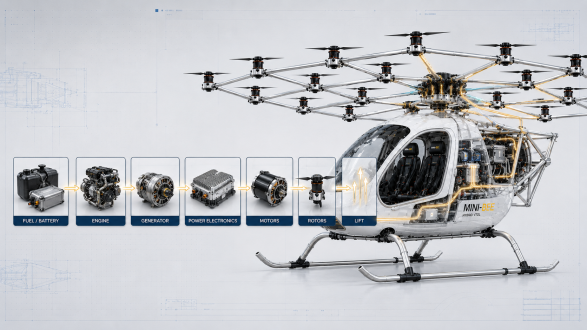
Lift / thrust system
Hybrid chain from energy source to distributed propellers.- MiniBee Low Level Evidence Matrix.png
Compliance evidence
Requirements, analyses, tests, inspections and demonstrations.

Project overview
The Mini-Bee / Red VTOL concept is a hybrid VTOL aircraft project based on a distributed lift architecture.
From a certification point of view, the aircraft must be treated carefully because it is not a conventional helicopter and not a conventional aeroplane. It combines rotorcraft behaviour with VTOL-capable characteristics.
The current certification logic is therefore based on two main references:
- CS-27 Small Rotorcraft for the rotorcraft basis;
- SC-VTOL-02 for VTOL-capable specific aspects.
This dual approach helps structure the project without ignoring the innovative features of the aircraft.
High Level Certification Framework
The high level framework answers one main question:
- Where does Mini-Bee / Red VTOL fit inside the EASA certification environment?
The current positioning is:
| Reference | Role |
|---|---|
| CS-27 | Main basis for small rotorcraft certification. |
| SC-VTOL-02 | Complementary framework for VTOL-capable characteristics. |
| CS-VLR | Possible reference only if the aircraft fits very light rotorcraft restrictions. |
| CS-29 | Reference for complex rotorcraft aspects or if the design exits CS-27 boundaries. |


At this level, the key point is to avoid a late reclassification risk.
A design initially considered under CS-27 may be pushed toward more demanding expectations if it exceeds boundaries related to mass, occupants, complexity, power architecture, operating mode or public transport use.
EASA as official source
EASA is the official European authority for aviation safety and certification.
For Mini-Bee / Red VTOL, every certification reference must be checked from official EASA sources:
- certification specifications;
- special conditions;
- acceptable means of compliance;
- guidance material;
- rulemaking tasks;
- consultation documents;
- easy access rules;
- official FAQs and product lists.
This is important because certification work must rely on validated texts, with clear issue dates and amendment levels.
Main EASA references
| Reference | Main use for Mini-Bee / Red VTOL |
|---|---|
| CS-27 | Small rotorcraft certification basis. |
| SC-VTOL-02 | VTOL-capable aircraft specific requirements. |
| CS-VLR | Very light rotorcraft reference, under strict limitations. |
| CS-29 | Large rotorcraft reference for complex or higher-category aspects. |
| CS-E | Engine certification. |
| SC E-19 | Electric and hybrid propulsion system certification. |
| CS-P | Propeller certification. |
| CS-26 | Additional airworthiness specifications for operations. |
| AMC-20 | Products, parts and appliances. |
| CS-34 | Aircraft engine emissions and fuel venting. |
System and sub-system framework
The medium level framework links the aircraft-level certification basis to each major technical domain.
For Mini-Bee / Red VTOL, the most important domains are:
- thermal engine;
- electric and hybrid propulsion system;
- propellers or rotors;
- high-power electrical architecture;
- distributed lift system;
- operational airworthiness;
- emissions and fuel venting;
- noise and environmental constraints.

Placeholder visual showing CS-E, SC E-19, CS-P, CS-26, AMC-20 and CS-34 around the Mini-Bee architecture.
The main technical point is the definition of the complete lift / thrust system.
For Mini-Bee, this system should include the complete chain:
| Chain element | Certification attention point |
|---|---|
| Fuel / energy source | Safety, storage, venting, endurance and environmental constraints. |
| Thermal engine | CS-E, installation, operating limits and integration. |
| Electrical generation | Power conversion, reliability and degraded modes. |
| Power electronics | Thermal control, electrical safety and EMC. |
| Electric motors | Redundancy, failure cases and thrust control. |
| Propellers / rotors | CS-P, loads, vibration, safety and noise. |
| Flight control logic | Command, monitoring, degraded modes and safety analysis. |
Low Level demonstration
The low level framework is the level of evidence.
At this stage, the project must demonstrate that each requirement is satisfied through traceable proof.
Typical evidence includes:
- analyses;
- calculations;
- simulations;
- safety assessments;
- system schematics;
- bench tests;
- HIL / SIL tests;
- inspections;
- qualification reports;
- flight test preparation;
- flight test reports.

Placeholder visual showing the link between requirements, means of compliance and project deliverables.
This level is essential because certification is not based on intention. It is based on documented, verifiable and reviewable evidence.
Main certification risks
| Risk | Why it matters |
|---|---|
| Boundary between CS-27 and SC-VTOL | Mini-Bee combines rotorcraft behaviour and VTOL-capable characteristics. |
| Possible move toward CS-29 expectations | Complexity, mass, occupants or operations may increase the certification burden. |
| Hybrid propulsion | The propulsion chain may need to be treated as an integrated safety-critical system. |
| High electrical power | Electrical architecture, EWIS and EMC require specific attention. |
| Distributed lift | Failure modes and degraded operation must be clearly demonstrated. |
| VEMS / medical mission | Emergency medical use may introduce additional operational constraints. |
Certification maturity logic
The certification framework for VTOL-capable aircraft is still evolving.
Mini-Bee / Red VTOL should therefore keep a living certification watch on:
- SC-VTOL updates;
- new means of compliance;
- EASA Rotorcraft and VTOL Safety Symposium outputs;
- electric and hybrid propulsion guidance;
- environmental rules;
- operational rules for VTOL-capable aircraft;
- pilot training and licensing evolutions.
This point is important for the transition toward a stronger demonstrator phase.
What the presentation clarified
The PowerPoint presentation clarified several key points:
| Topic | Clarification |
|---|---|
| Aircraft classification | Mini-Bee can be considered as a small rotorcraft with VTOL-capable characteristics. |
| Main certification basis | CS-27 should be used as the main rotorcraft basis. |
| VTOL complement | SC-VTOL-02 is needed for specific VTOL-capable features. |
| System certification | Engine, hybrid propulsion, propellers and electrical systems require dedicated references. |
| Design risk | The project must avoid unintentionally exiting the CS-27 frame. |
| Future work | Each certification text must be analysed in detail to deduce constraints and design options. |
Questions to solve before a future certification phase
Before moving toward a more advanced certification phase, several questions must be clarified:
- What is the final certified mass target?
- What is the final occupant configuration?
- Which parts of the hybrid propulsion chain can rely on certified components?
- How should the integrated lift / thrust system be demonstrated?
- Which degraded modes must be demonstrated?
- What operational category should be targeted?
- How far should the VEMS mission be included in the first certification logic?
- Which EASA discussions or consultations should the project enter?
Suggested visuals to create
| Visual | Purpose |
|---|---|
| MiniBee_VTOL_Certification_Framework_Overview.png | Global cover visual for the page. |
| MiniBee_High_Level_Certification_Map.png | Show CS-27, SC-VTOL-02, CS-29 and CS-VLR around Mini-Bee. |
| MiniBee_CS27_SCVTOL_Positioning.png | Explain the dual positioning: rotorcraft basis + VTOL-capable complement. |
| MiniBee_Lift_Thrust_System_Chain.png | Show the complete hybrid chain from fuel to propellers. |
| MiniBee_Medium_Level_System_Map.png | Map systems and sub-systems to certification references. |
| MiniBee_Low_Level_Evidence_Matrix.png | Show requirements linked to evidence and means of compliance. |
| MiniBee_Certification_Pathway.png | Final synthesis visual: concept → framework → compliance → tests → approval. |
Useful links
- File:20260422 RedVTOL EASA Certification 01 High Level Framework v2 en.pptx
- Mini-Bee
- Minibee_TRL3
- RED VTOL
- CS-27
- SC-VTOL-02
- Hybrid Propulsion
Why this framework matters
The VTOL Certification Framework is essential because Mini-Bee / Red VTOL cannot be assessed only through performance or innovation.
The aircraft must also be understandable, justifiable and demonstrable from a certification point of view.
This framework helps the project move from an innovative VTOL concept toward a structured, traceable and credible aircraft development path.

Placeholder visual showing the progression from concept definition to certification evidence and operational approval.