Difference between revisions of "Minibee TRL4"
Wiki.admin (talk | contribs) |
Wiki.admin (talk | contribs) |
||
| (2 intermediate revisions by the same user not shown) | |||
| Line 416: | Line 416: | ||
<div style="border:1px solid #cfd6dd; background:#f6f8fa; padding:14px; margin-top:16px;"> | <div style="border:1px solid #cfd6dd; background:#f6f8fa; padding:14px; margin-top:16px;"> | ||
| − | '''Next maturity step:''' TRL 5 – Technology Validated in Relevant Environment. | + | '''Next maturity step:''' [[Minibee TRL5|Mini-Bee TRL 5]] – Technology Validated in Relevant Environment. |
</div> | </div> | ||
| Line 423: | Line 423: | ||
== See also == | == See also == | ||
| − | * [[Minibee TRL1| | + | * [[Minibee TRL1|Mini-Bee TRL 1]] |
| − | * [[Minibee TRL2| | + | * [[Minibee TRL2|Mini-Bee TRL 2]] |
| − | * [[Minibee TRL3| | + | * [[Minibee TRL3|Mini-Bee TRL 3]] |
* [[Mini-Bee|Mini-Bee project]] | * [[Mini-Bee|Mini-Bee project]] | ||
[[Category:MiniBee]] | [[Category:MiniBee]] | ||
[[Category:Technology Readiness Levels (TRL)]] | [[Category:Technology Readiness Levels (TRL)]] | ||
| − | [[Category:TRL4]] | + | [[Category:Minibee TRL4]] |
[[Category:Collaborative Bee]] | [[Category:Collaborative Bee]] | ||
Latest revision as of 09:54, 11 May 2026
TRL 4 – Mini-Bee | Technology Validated in Laboratory
|
At TRL 4, the Mini-Bee project entered a more advanced demonstrator-oriented phase. The objective of this stage is to validate key technologies in controlled environments, including the hybrid power chain, the physical and digital mock-ups, the Flight Control Unit, the structural assumptions and the first subsystem test benches. This page documents the active TRL 4 work carried out during the 2022/2023 academic year and the continuation of the Mini-Bee development after TRL 3. |
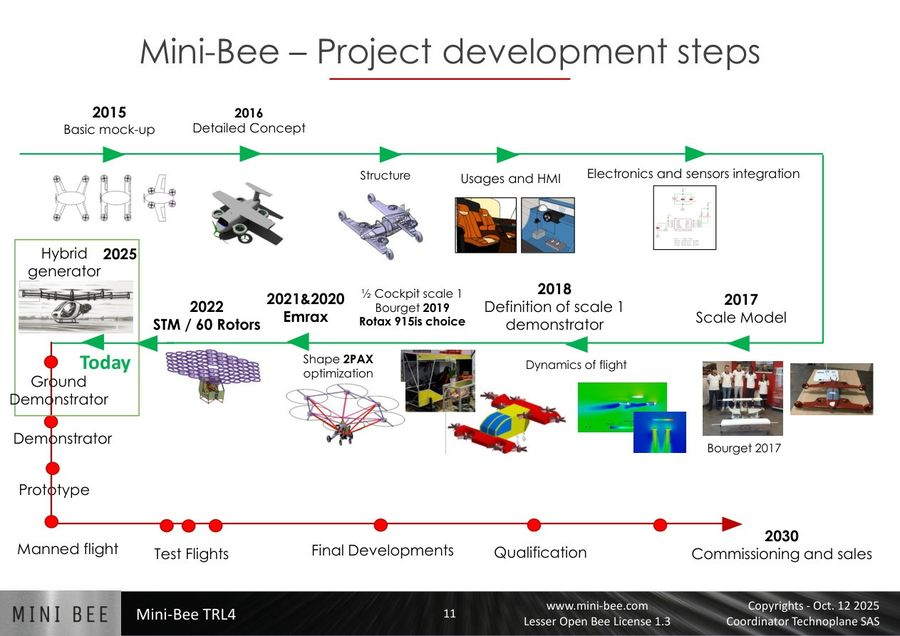
Mini-Bee project development roadmap – TRL4 transition
|

Quick project summary
|
Project |
TRL stage |
Main period documented |
Main focus |
TRL 4 visual overview
|
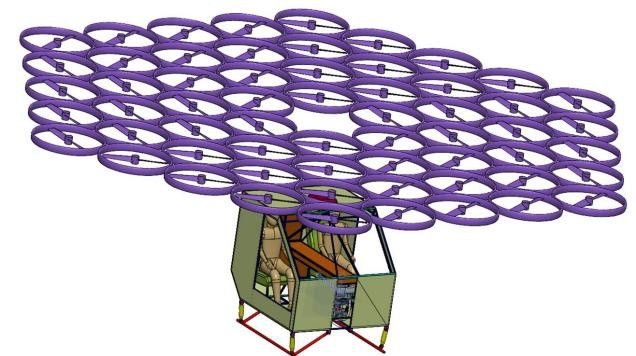
Rotor architecture
Front view of the historical TRL4 distributed rotor configuration.
|
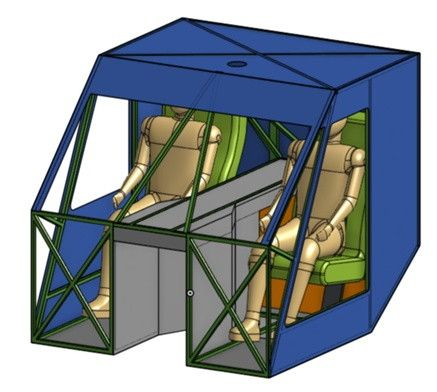
Cockpit structure
Cockpit and seat integration mock-up used for structure and ergonomic studies.
|
Development roadmap
Project development steps showing the progression from early mock-ups to demonstrator work.
|


Previous TRL steps
|
TRL 1 – Basic principles observed Initial mission need, basic principles and first assumptions. |
TRL 2 – Technology concept formulated First concept configuration, academic studies and early mock-ups. |
TRL 3 – Experimental proof of concept Simulations, technical reviews, FCU prototypes and early test benches. |
Visual introduction – 2023 work
|
File:15 02 2023 Soutenance finale compressed.pdf Ecole Centrale Lille
Technical contribution and project presentation.
|
File:202305 Projet MiniBee Soutenance finale corrigé.pdf Power chain
Estaca Bordeaux work on the Mini-Bee power chain.
|
File:202305 Soutenance MiniBee ESTACA 3A BDX Structure.pdf Physical mock-up
Reduced-scale physical mock-up and structural work.
|
|
File:2023 05 09 Soutenance.pdf Digital mock-up
Estaca SQY digital mock-up and configuration studies.
|
File:202305 Présentation Soutenance versionF.pdf Hybrid propulsion
Work on hybrid propulsion architecture and assumptions.
|
File:25042023 Présentation final MiniBee.pdf FCU prototype
Cytech work on the Flight Control Unit prototype.
|
Project overview
TRL 4 – Technology Validated in Laboratory corresponds to the stage where the Mini-Bee project started to consolidate and validate key technologies in controlled or representative environments.
At this level, the project is no longer only based on theoretical assumptions. The work begins to focus on subsystem validation, prototype logic, test benches, mock-ups, control architecture and the preparation of more representative demonstrator activities.
TRL 4 objective: validate the main technical building blocks of the Mini-Bee concept through laboratory work, mock-ups, subsystem studies and early controlled testing.
Tasks of academic year 2022 / 2023
The 2022/2023 period focused on several major technical work packages: power chain, physical mock-up, digital mock-up, hybrid propulsion and Flight Control Unit development.
| Contributor | Work package | Documents |
|---|---|---|
| Ecole Centrale Lille | Technical contribution and project presentation | |
| Estaca Bordeaux 3A | Power chain | |
| Estaca Bordeaux | Reduced-scale physical mock-up | |
| Estaca SQY | Digital mock-up | |
| Estaca SQY | Hybrid propulsion |
FCU tasks
The Flight Control Unit is a critical subsystem for Mini-Bee because the aircraft relies on distributed electric propulsion and computerized flight control logic.
During TRL 4, several academic teams worked on FCU-related tasks, including prototype logic, STM / Arduino exercises, control studies and system architecture.
| Contributor | Scope | Documents |
|---|---|---|
| Estaca SQY 4A | FCU development and presentation | File:20230425 Soutenance finale P2I 4A.pdf |
| Cytech | FCU prototype and project work | File:25042023 Présentation final MiniBee.pdf |
| Esigelec | FCU / electrical system work | File:20230203 ESIGELEC PING2 réunion 10.pdf |
Arduino and STM exercises – FCU 2022 / 2023
The FCU training and prototyping work also included Arduino and STM Nucleo exercises carried out by Estaca and Cytech.
|
Arduino FCU |
STM Nucleo FCU |
Arduino FCU – English |
STM Nucleo FCU – English |
Main TRL 4 technical areas
|
Hybrid power chain Work on the generation, conversion and distribution of electrical power for distributed propulsion. |
Physical mock-up Reduced-scale and structural mock-up activities to support integration and configuration studies. |
Digital mock-up Digital model development to improve the understanding of aircraft layout, structure and integration. |
|
Hybrid propulsion Studies on the interaction between thermal generation and electric propulsion systems. |
Flight Control Unit FCU development, control logic, STM exercises and distributed rotor control preparation. |
Subsystem validation Preparation of laboratory validation logic before full demonstrator integration. |
TRL 4 configuration visuals
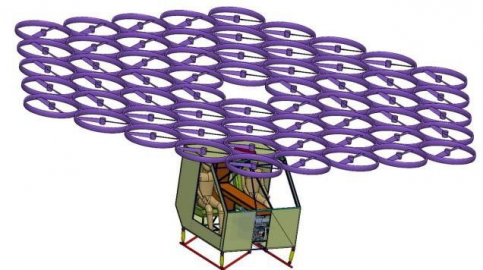
Distributed rotor architecture
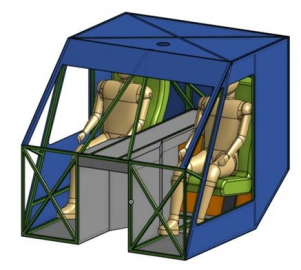
Cockpit structure and seat integration
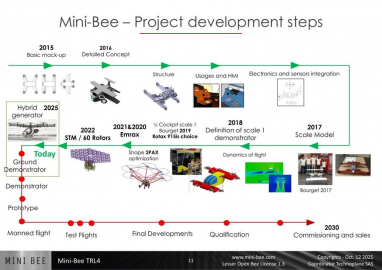
Project development steps
TRL 4 development logic
The TRL 4 phase supports the transition from proof of concept to controlled validation of key technologies.
| 1. Consolidate | 2. Prototype | 3. Validate | 4. Integrate | 5. Prepare TRL 5 |
| TRL 3 results | FCU, mock-ups and power chain | Laboratory and controlled tests | Subsystem consistency | Relevant environment validation |
What TRL 4 covered
|
Covered during TRL 4
|
Still open after early TRL 4 work
|
Visual archive – 2023 documents
The following documents support the TRL 4 visual and technical archive for the 2022/2023 academic year.
|
File:202305 Rapport de projet industriel - Projet Mini-Bee.pdf Physical mock-up report
|
File:2023 05 09 Rapport final.pdf Digital mock-up report
|
File:20230425 Soutenance finale P2I 4A.pdf FCU presentation
|
Image and document files used on this page
| Wiki file name | Use in page | Link |
|---|---|---|
| MiniBee_TRL4_60_rotors_front_view.png | TRL4 rotor architecture visual | Open image |
| MiniBee_TRL4_cockpit_structure_mockup.png | Cockpit structure and seat integration visual | Open image |
| MiniBee_TRL4_project_development_steps.png | Hero visual and project development roadmap | Open image |
| 15 02 2023 Soutenance finale compressed.pdf | Visual introduction and Ecole Centrale Lille task | Open document |
| 202305 Projet MiniBee Soutenance finale corrigé.pdf | Visual introduction and power-chain task | Open document |
| 202305 Soutenance MiniBee ESTACA 3A BDX Structure.pdf | Visual introduction and physical mock-up task | Open document |
| 2023 05 09 Soutenance.pdf | Visual introduction and digital mock-up task | Open document |
| 202305 Présentation Soutenance versionF.pdf | Visual introduction and hybrid propulsion task | Open document |
| 25042023 Présentation final MiniBee.pdf | Visual introduction and FCU task | Open document |
| 202305 Rapport de projet industriel - Projet Mini-Bee.pdf | Visual archive and physical mock-up documentation | Open document |
| 2023 05 09 Rapport final.pdf | Visual archive and digital mock-up documentation | Open document |
| 20230425 Soutenance finale P2I 4A.pdf | Visual archive and FCU documentation | Open document |
Why TRL 4 matters
TRL 4 is a key maturity step because it connects the Mini-Bee concept to laboratory-level validation.
It helps transform the work from studies and proof-of-concept activities into controlled subsystem validation. It also prepares the project for later stages where technologies must be tested in more representative environments.
Transition to the next stage
Next maturity step: Mini-Bee TRL 5 – Technology Validated in Relevant Environment.
At TRL 5, the project should move from laboratory validation toward tests in conditions closer to real operational use.